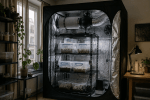
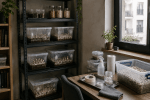

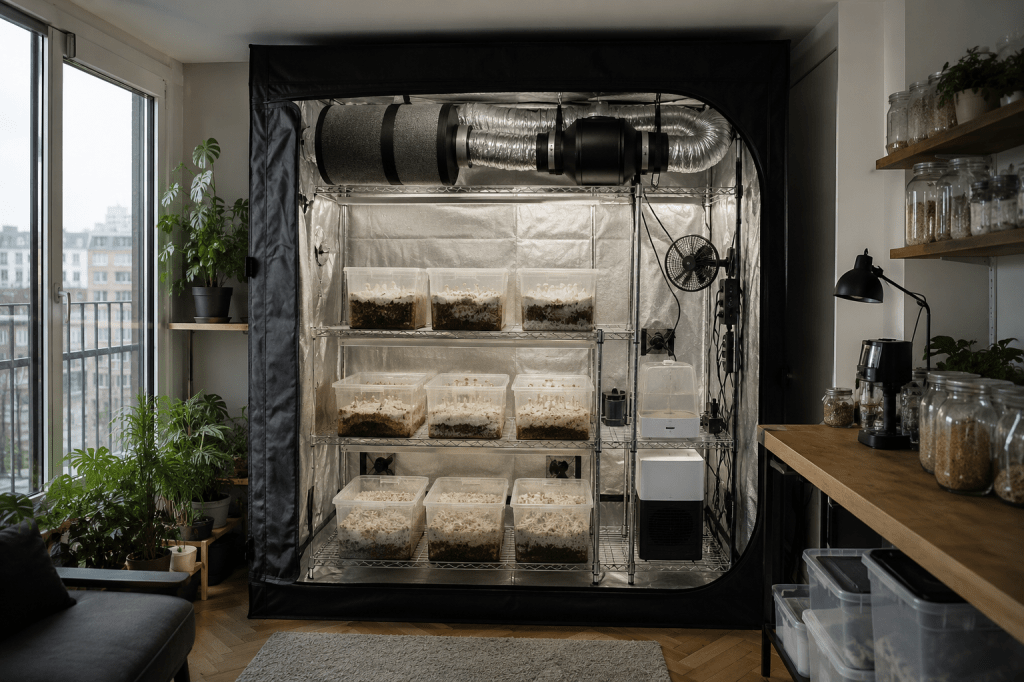
A grow tent introduces a set of airflow challenges that do not exist in smaller, passive fruiting setups. The enclosed volume is too large for natural diffusion to maintain adequate gas exchange across multiple fruiting blocks. Getting the airflow setup right in a grow tent has a disproportionate effect on fruiting performance.
This guide covers the components of an effective grow tent airflow system and how to configure them for mushroom fruiting specifically — which differs from cannabis cultivation, the most common use case for grow tent design guides.
Grow tent airflow: the core components
Inline fan (exhaust): The primary driver of air movement in a grow tent. An inline fan draws air from inside the tent and exhausts it outside. By creating negative pressure inside the tent, it causes fresh air to be drawn in through intake vents. Inline fans are rated in cubic metres per hour (m³/h) or cubic feet per minute (CFM).
Carbon filter: In mushroom cultivation, a carbon filter is optional — mushroom fruiting does not produce strong odours in most cases — but the connection point is the same as any other exhaust setup.
Clip fans or oscillating fans: Smaller fans positioned inside the tent to circulate air and prevent dead zones. These fans do not exchange air with the outside; they move the internal air volume.
Intake vents: Grow tents include mesh-covered vents at the lower sides. These are the passive intake points — when the exhaust fan creates negative pressure, air enters through these vents.
Humidity controller: An automated controller that reads internal humidity and switches the exhaust fan or a humidifier on and off to maintain a set point. For continuous operation without manual monitoring, a humidity controller is the most important automation addition for mushroom cultivation in a tent.
Key differences from cannabis grow tent setups
Most grow tent airflow information is written for cannabis cultivation. These configurations are poorly suited to mushroom cultivation for three reasons.
Cannabis setups run high, continuous airflow. Mushroom fruiting requires gas exchange but cannot tolerate the moisture loss that comes with very high continuous airflow. A grow tent designed for cannabis, running at full exhaust capacity continuously, will desiccate mushroom fruiting blocks.
Cannabis setups target low humidity. Cannabis cultivation generally targets 50–70% relative humidity. Mushroom fruiting targets 85–95%. A setup calibrated for cannabis humidity ranges will not produce adequate fruiting conditions without modification.
Cannabis setups use CO₂ supplementation. Mushroom cultivation does not benefit from CO₂ supplementation; the goal is CO₂ removal. Starting from a cannabis-configured grow tent and adapting it for mushrooms requires reducing airflow, increasing humidity targets, and eliminating any CO₂ supplementation.
Sizing the inline fan
The inline fan should exchange the tent’s air volume several times per hour during active fruiting. A common starting point is 6–10 air changes per hour.
To calculate: multiply the tent’s volume (length × width × height in metres) by the desired air changes per hour. A 60×60×120cm tent has a volume of 0.43 m³. At 10 air changes per hour, the required fan capacity is approximately 4.3 m³/h. A standard inline fan rated at 100 m³/h would be vastly oversized for this space at full power.
This is why fan speed controllers are useful in mushroom cultivation contexts. A variable-speed controller allows the fan to run at 5–15% of rated capacity, providing adequate gas exchange without the moisture loss that comes from full airflow. Running a fan rated at 100 m³/h at 10% output gives approximately 10 m³/h — a more appropriate rate for a tent of this size.
Fan positioning for mushroom cultivation
Exhaust fan position: At the top of the tent, exhausting through the upper ducting port. Hot, CO₂-rich air rises and is most concentrated at the top of the tent. Top exhaust removes the highest-CO₂ air most efficiently.
Intake position: Lower mesh vents should be partially open to allow passive intake. Fresh air entering at the bottom displaces the CO₂-rich air upward toward the exhaust point. This vertical flow path is more effective than intake and exhaust positioned at the same height.
Interior clip fans: Position them to move air across the fruiting blocks without directing high-velocity air directly at fruiting body surfaces. Direct, high-velocity airflow on developing fruiting bodies causes localised desiccation. Lower speed, indirect circulation is preferable.
Intake filtering: Open mesh vents allow airborne contamination to enter. Some cultivators cover intake vents with polyester fibre or micropore tape to provide basic filtration. This slightly reduces intake airflow but reduces contamination pressure in the tent environment.
Humidity management in a tent
As the humidity management guide discusses, airflow and humidity are in tension. A tent running continuous exhaust will lose moisture faster than substrate evaporation can replace it. The standard solution in tent-based mushroom cultivation is an ultrasonic humidifier controlled by a humidity controller.
Humidifier positioning: Place the humidifier inside the tent, near the base, where its output is drawn upward by the airflow and distributed through the tent volume. Avoid positioning the humidifier output directly at fruiting body surfaces, which can cause surface saturation and bacterial contamination.
Humidity controller setup: For most tent-based setups, a humidity controller switching the humidifier on at 85% RH and off at 92% RH provides a stable range during active fruiting. The exhaust fan runs independently on a timer or variable speed controller for consistent gas exchange.
Monitoring: Place a hygrometer at fruiting block height inside the tent. A second hygrometer at block level confirms the environment is within target range where it matters — readings at the controller sensor may not reflect conditions across the full tent if circulation is uneven.
Timer and controller setups
Exhaust fan on a timer: If a humidity controller is not available, the exhaust fan can be run on an interval timer — on for 15 minutes every two hours — to provide periodic gas exchange without continuous moisture loss.
Humidity controller switching exhaust fan: The controller switches the exhaust fan off when humidity drops below the set point. This preserves moisture but can allow CO₂ to build if fruiting blocks are producing it faster than the fan cycles can remove it. Monitor pin morphology to confirm gas exchange remains adequate.
Combined setup: Exhaust fan on a variable speed controller for baseline continuous low airflow, plus a humidity controller managing a humidifier for moisture addition. This is the most reliable configuration for consistent results.
Troubleshooting common tent airflow problems
Pins are elongated, caps underdeveloped: CO₂ is too high. Increase exhaust fan speed or frequency. Reduce intake filter restriction if applicable.
Humidity drops to 70% or below during active fruiting: Airflow is removing moisture faster than it can be replaced. Reduce fan speed, add active humidification, or partially close intake vents to slow the exchange rate.
Condensation dripping onto blocks from tent ceiling: Increase exhaust rate or reduce ambient temperature differential. Alternatively, position a drip shield above the fruiting blocks to intercept drips.
Uneven fruiting across blocks: Air circulation is uneven. Reposition clip fans to distribute air more evenly. Rotate block positions between flushes.
Equipment summary
A functional grow tent airflow setup for mushroom cultivation at small scale requires: an inline fan (50–125mm depending on tent volume) with variable speed controller; a humidity controller with sensor placed at fruiting block height; an ultrasonic humidifier sized for the tent volume (typically 200–500 mL/h output for tents up to 120×60cm); one or two clip fans for interior circulation; and a hygrometer for monitoring at multiple points.
Total cost for this equipment at entry-level specifications is typically €60–120, varying by brand and source. More on individual equipment specifications and European availability in our equipment comparison guides.
Summary
A grow tent configured for mushroom cultivation requires lower airflow than equivalent setups for other crops, active humidity management to compensate for that airflow, and attention to airflow distribution to prevent both dead zones and localised desiccation.
The critical adjustments from a standard cannabis-configured tent are: reduce exhaust fan to 5–15% of rated capacity via speed controller, set humidity targets to 85–95% rather than 50–70%, and add active humidification to compensate for moisture loss. With these adjustments, a grow tent provides a controllable, scalable environment for fruiting that outperforms passive single-container setups when running multiple blocks simultaneously.


Leave a comment