


When relative humidity in a fruiting chamber drops below target range, the immediate instinct is often to mist more frequently or add a humidifier. These responses address the symptom rather than the cause, and frequently introduce secondary problems: surface saturation from over-misting, or humidity overshoot from equipment without precise control.
Effective troubleshooting starts with identifying where the moisture is going, not with adding more of it. The mechanisms of humidity loss in a fruiting environment are consistent and identifiable; matching the fix to the cause produces more stable outcomes than increasing moisture input indiscriminately.
The moisture balance in a fruiting chamber
A fruiting chamber is, from a moisture perspective, a system with inputs and outputs.
Inputs: Evaporation from the substrate surface, evaporation from perlite or other moisture-retaining material, and any moisture added by misting or active humidification.
Outputs: Moisture carried out by airflow during ventilation, moisture absorbed into developing fruiting bodies, and any water draining from the substrate.
When the system is in balance, relative humidity stays within the target range. Humidity drops when outputs exceed inputs — either because outputs have increased or inputs have decreased. Identifying which has changed is the diagnostic starting point.
Common causes of humidity loss
1. Ventilation frequency or volume is too high
The most common cause. Airflow carries moisture out of the fruiting environment. A fruiting chamber that has been working well and begins showing humidity loss after ventilation adjustments has typically tipped the balance between gas exchange and moisture retention.
Fix: Reduce ventilation frequency or duration. If running manual FAE, reduce fanning sessions from four times daily to two. If running passive exchange with polyfill holes, add polyfill to slightly restrict flow. Monitor both humidity and pin morphology: if humidity recovers but pins show elongation or cap underdevelopment, ventilation has been restricted too far.
2. Substrate moisture is depleting
As a fruiting block or bulk substrate progresses through successive flushes, its moisture content decreases. A substrate that maintained good humidity through the first flush may struggle to do so through the second or third as internal moisture depletes.
Fix: Rehydration between flushes. Soaking a block in water for 6–12 hours before initiating a subsequent flush restores some of the moisture lost during previous fruiting. This extends the productive life of a substrate and restores its capacity as a passive humidity source.
3. Ambient humidity is very low
A fruiting chamber is not fully isolated from its environment. In conditions of very low ambient humidity — dry climates, air-conditioned spaces, or heated rooms during winter — the humidity gradient between the interior and exterior of a semi-sealed container creates outward diffusion pressure.
Fix: Increase sealing of the fruiting environment, reduce hole size or polyfill permeability, or address the ambient environment by running a room humidifier. Moving the setup to a naturally more humid location in the space can also help.
4. Container geometry creates cold spots
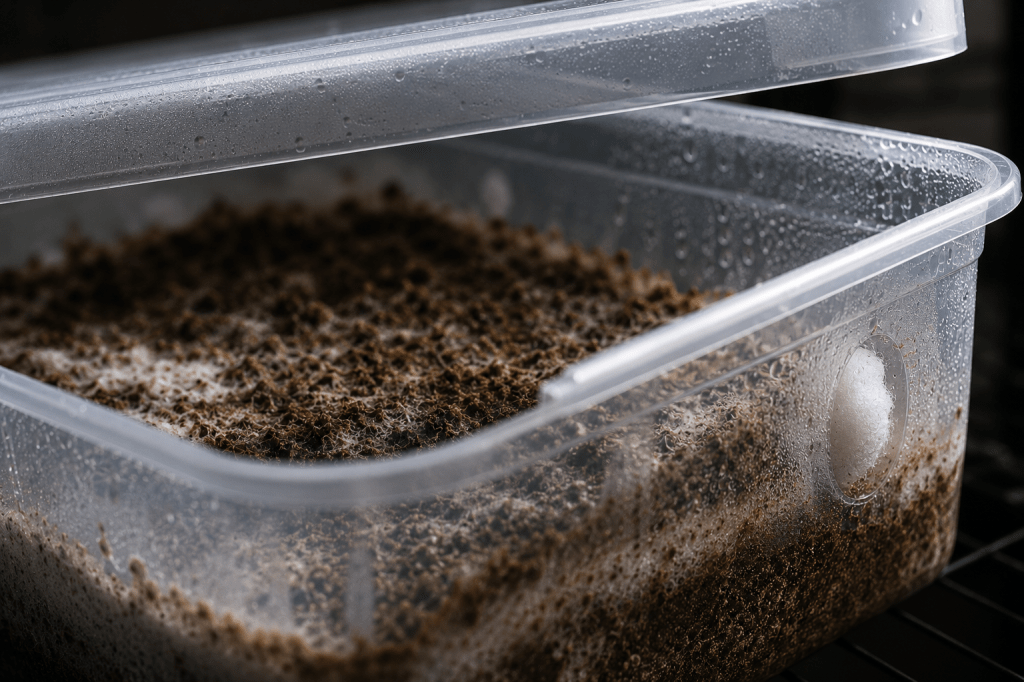
In some fruiting container designs, temperature differentials within the container cause localised condensation. Moisture condenses on the coldest surface — often the lid or the side nearest an exterior wall — and drips down rather than remaining in the air.
Fix: Insulate the cold surface, move the container away from cold external surfaces, or adjust temperature management to reduce the differential.
5. Perlite layer is drying out
Where perlite is used as a passive moisture buffer, it requires periodic rehydration. Perlite loses moisture to evaporation over time and will eventually dry out if not maintained. A dried perlite layer no longer contributes to humidity and may actually absorb moisture from the substrate and fruiting bodies.
Fix: Rehydrate the perlite layer by adding water directly to it until saturated but not pooling.
Misting technique and its limits
Manual misting is the most accessible intervention for humidity loss, but it has limitations worth understanding.
Misting raises humidity transiently. Spraying water into the fruiting chamber raises relative humidity immediately. However, unless the moisture source that created the deficit is addressed, humidity will drop again at the same rate.
Mist walls, not substrate. As described in the humidity management guide, misting directly onto the substrate surface repeatedly increases contamination risk. The target for misting is the interior walls and lid.
Misting frequency is a proxy for system health. A well-designed fruiting environment should require misting once or twice daily at most during active fruiting. If a setup requires misting every hour, the system has a structural issue that should be addressed directly.
Diagnosing the cause systematically
Step 1: Check ventilation settings first. Has anything changed in fan cycling, fanning frequency, or hole coverage? Adjust and observe for 24–48 hours.
Step 2: Assess substrate moisture. Has the block been through multiple flushes without rehydration? Rehydrate and reassess.
Step 3: Check ambient conditions. Use a hygrometer to measure ambient RH. If it has dropped significantly, address the ambient environment.
Step 4: Inspect perlite (if used). Is it dry or only slightly damp? Rehydrate it.
Step 5: Check for cold spots. Is condensation concentrating in one area? Address positioning or insulation.
Most humidity loss issues resolve at step 1 or 2.
When to use active humidification
For setups running high airflow — Martha tents, large grow rooms, continuous fan operation — passive moisture management cannot keep pace with moisture loss. In these environments, an ultrasonic humidifier on a timer or humidity controller provides stable, automated moisture maintenance.
The decision point is practical: if manual misting more than twice daily is required and the underlying cause is not addressable, active humidification is the appropriate next step.
Summary
Humidity loss in a fruiting chamber is a balance problem. Outputs — primarily ventilation and substrate depletion — are exceeding inputs. Identifying which output has increased or which input has decreased determines the appropriate response.
The most common causes are over-ventilation and substrate moisture depletion, both straightforward to address. Ambient humidity, perlite maintenance, and cold spot condensation are secondary causes that become relevant when the primary ones have been ruled out.
Misting is a tool for supplementing moisture, not for compensating for an undiagnosed structural deficit. A stable fruiting environment should require minimal active intervention once the balance is correctly calibrated.


Leave a comment