




“Fresh air exchange” and “passive air exchange” appear frequently in cultivation discussion, sometimes used interchangeably, sometimes as opposites. The distinction matters practically, but it is not always clearly defined.
Both terms describe the same underlying need: removing CO₂-rich air from a fruiting environment and replacing it with air containing lower CO₂ concentrations. What differs is the mechanism — whether air movement is driven by a fan or pump (active / FAE), or by natural convection and diffusion (passive).
Understanding the difference helps in evaluating whether a setup is meeting its gas exchange requirements, and in deciding which approach is appropriate for a given cultivation format.
Why gas exchange is necessary
Metabolically active mycelium and developing fruiting bodies respire continuously, consuming oxygen and releasing CO₂. In a sealed environment, CO₂ accumulates while oxygen depletes. If this continues unchecked, the fruiting environment becomes unfavourable for pin initiation and fruiting body development.
The CO₂ threshold that begins to affect fruiting varies by species, but a general figure often cited in cultivation literature is around 1,000–2,000 ppm. Ambient atmospheric CO₂ is approximately 420 ppm. A sealed fruiting chamber with active colonised substrate can exceed 5,000 ppm within hours.
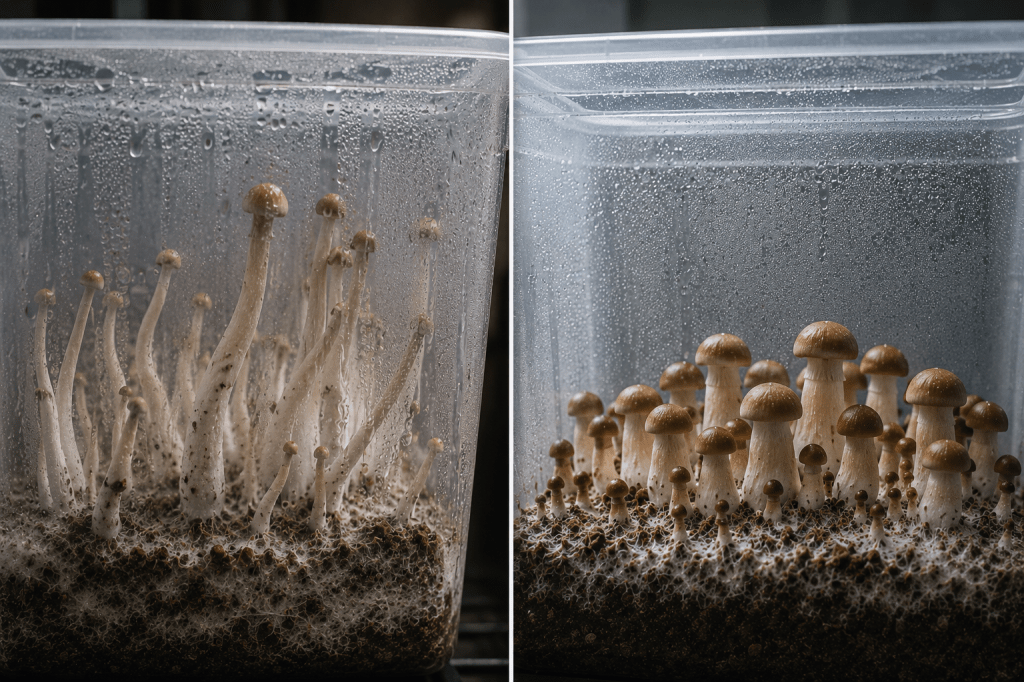
The practical consequence: mushrooms in high-CO₂ environments either do not pin, pin poorly, or produce distorted fruiting bodies — typically elongated stems with underdeveloped caps. The organism is responding to chemical signals that, in its evolutionary context, indicate it is still buried and not yet exposed to the atmosphere.
A broader explanation of CO₂ effects on fruiting is in our airflow and fruiting guide.
Passive air exchange
Passive air exchange relies on the physical principles of gas diffusion and convection to move air through a growing container without mechanical assistance.
Diffusion operates at the molecular level. Gas molecules move from areas of higher concentration to areas of lower concentration. In a partially sealed container — one with holes, gaps, or permeable materials — CO₂ naturally diffuses outward over time, and ambient air diffuses inward.
Convection operates through temperature and density differences. Warm air rises; cool air falls. CO₂ is slightly denser than ambient air; it tends to accumulate at lower elevations. In a container with holes positioned at both the top and bottom, natural convection creates a slow vertical circulation: CO₂-rich air exits through lower holes, ambient air enters through upper holes, or vice versa depending on temperature gradients.
Polyfill and micropore tape are filtration materials used in passive exchange designs. Holes in container walls are packed with polyfill fibre or covered with micropore surgical tape. These materials allow gas diffusion while providing a barrier against airborne contamination — fungal spores and bacterial particles that would otherwise enter through open holes.
The effectiveness of passive exchange depends on the size and number of exchange points, the permeability of any filtration material, and the differential between internal CO₂ concentration and ambient. A heavily colonised substrate block in a sealed tub with small holes may exchange gas slowly enough that CO₂ builds faster than it diffuses out.
Fresh air exchange (FAE)
FAE in cultivation contexts typically refers to active, mechanically driven air exchange. A fan moves air through or across the fruiting environment, replacing the internal atmosphere more rapidly than passive diffusion achieves.
Direct FAE introduces ambient air into a fruiting environment continuously or on a timed cycle. Small computer fans — 80mm or 120mm — are commonly used in small-scale setups. They draw air in through one opening and exhaust through another, creating a defined airflow path.
Indirect FAE relies on fans positioned near the fruiting environment rather than directly introducing air into it. In Martha tent configurations, a fan circulates air within the tent environment; the fruiting blocks within the tent experience this circulation as gas exchange.
The advantage of active FAE over passive exchange is throughput: a small fan can exchange the air volume of a fruiting chamber many times per hour, maintaining CO₂ concentrations close to ambient regardless of how much CO₂ the substrate produces. The trade-off is moisture loss.
What the setup determines
Different cultivation formats are suited to different exchange approaches, and the choice is not arbitrary.
Monotubs are designed around passive exchange. The standard monotub design — a large plastic storage container with holes drilled in the sides and filled with polyfill — relies on diffusion and convection to maintain adequate gas exchange. The design works because the relatively large substrate volume provides substantial CO₂ buffering, and the tight-fitting lid limits moisture loss. Most monotub cultivators do not use fans.
When a monotub underperforms on gas exchange — producing distorted fruiting bodies or poor pinning — the adjustment is typically increasing hole size, adding holes, or reducing polyfill density rather than introducing active ventilation.
Martha tent setups integrate active FAE as a design requirement. The tent environment is too large and too open for passive exchange to maintain CO₂ at appropriate levels across multiple fruiting blocks. Fans are necessary. Humidity is then managed actively to compensate for moisture loss from fan operation.
Shotgun fruiting chambers operate on aggressive passive exchange — many holes on all sides create high passive airflow through pressure differentials. They excel at gas exchange but sacrifice humidity retention significantly, requiring regular misting to compensate.
Manual FAE
Between fully passive and fully active is manual FAE: the cultivator opens the container, fans the air manually, and closes it again on a scheduled basis. This is common in monotub cultivation and represents a reasonable middle point.
Manual FAE is effective when performed consistently. A 30-second fanning session 2–4 times daily exchanges the air in a standard monotub adequately during active fruiting. The substrate provides enough moisture to restore humidity between sessions.
The limitation is consistency. A cultivation system that depends on manual intervention performs well when the intervention happens and poorly when it doesn’t. For cultivators who travel or have irregular schedules, passive systems or automated active systems are more reliable.
What actually determines performance
The key variable is not which approach is used but whether CO₂ concentration in the fruiting environment stays below the threshold that affects the species being cultivated. Both passive and active exchange can achieve this. Both can fail to achieve it if the design is inadequate for the substrate volume and activity level.
Indicators of adequate exchange: pins initiate within the expected timeframe for the species; fruiting bodies show appropriate stem-to-cap proportions; no characteristic elongation or cap underdevelopment.
Indicators of inadequate exchange: pinning delay beyond typical timelines; thin, elongated stems with small, poorly developed caps; abortions at early pin stages.
If a setup is showing these indicators, increasing exchange capacity — by whatever method the setup allows — should be the first intervention before adjusting other variables.
CO₂ measurement
The most direct way to assess whether gas exchange is adequate is to measure CO₂ concentration directly. Affordable NDIR CO₂ sensors are available in the €30–80 range with accuracy sufficient for cultivation purposes. A reading consistently above 2,000 ppm during fruiting suggests exchange is inadequate; a reading in the 600–1,200 ppm range during active fruiting suggests the exchange design is working.
Without a meter, pin morphology and development timelines remain the best proxies, as described above.
Summary
Fresh air exchange and passive air exchange describe the same need — CO₂ removal from the fruiting environment — achieved through different mechanisms. Active FAE uses fans; passive exchange uses diffusion and convection through designed openings.
Neither approach is universally superior. The appropriate choice depends on the cultivation format, substrate volume, species requirements, and the cultivator’s preference for active versus passive management. What matters is that CO₂ concentration stays within the range that supports the species being cultivated — and that fruiting body morphology confirms this is happening.


Leave a comment