



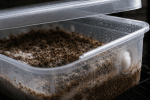
A common point of confusion for new cultivators is the role of humidifiers in mushroom fruiting. Commercial cultivation operations and Martha tent setups visible on hobbyist forums often include ultrasonic humidifiers as standard equipment, which can give the impression that active humidity control is necessary for all fruiting environments.
It is not. For most small-scale setups — monotubs, fruiting boxes, single blocks — substrate moisture is the primary humidity source, and maintaining it does not require active equipment. Understanding where fruiting humidity actually comes from makes the system much easier to manage.
Where fruiting humidity comes from
In a closed or semi-closed fruiting environment, relative humidity is driven by two sources: evaporation from the substrate surface and evaporation from any perlite or moisture-retaining material in the chamber base.
Substrate moisture is the dominant variable. A well-hydrated colonised block or bulk substrate continuously releases water vapour into the surrounding air. In a sealed or semi-sealed environment, this evaporation raises and maintains relative humidity without any additional intervention. The substrate is, in effect, a passive humidifier.
Perlite — a silica-based mineral that absorbs and slowly releases water — is used in some fruiting chamber designs precisely for this reason. A layer of water-saturated perlite in the base of a fruiting chamber provides a secondary evaporation source that buffers humidity fluctuations.
What the substrate cannot do is compensate for large, continuous air volumes that carry moisture away faster than evaporation can replace it. This is where active humidification becomes relevant: in high-airflow setups where the balance between ventilation and humidity retention has been resolved in favour of ventilation.
Relative humidity targets by stage
Humidity requirements shift across the cultivation cycle.
Colonisation: Most species colonise effectively across a relatively wide humidity range. The substrate itself maintains internal moisture during colonisation regardless of ambient humidity, provided it was prepared at the correct field capacity. External humidity during colonisation is less critical than substrate moisture and is often managed simply by keeping the growing container closed or loosely covered.
Pinning initiation: The transition to fruiting conditions typically involves a humidity increase, both to signal environmental change and to support the development of forming primordia. Most commonly cultivated species initiate pins best at 90–95% relative humidity. High surface moisture — condensation on the substrate surface — can suppress pinning by blocking gas exchange at the surface; the target is humid air rather than wet surfaces.
Active fruiting: Developing fruiting bodies lose moisture through their surfaces. Sustained humidity in the 85–95% range during development supports full cap development and prevents premature veil tearing. Drops below 80% during active fruiting can cause caps to crack, curl, or dry prematurely.
Between flushes: After harvesting, the substrate rests and recovers. Humidity maintenance during this period is less critical. Many cultivators reduce active management between flushes, maintaining a closed or semi-closed environment without additional intervention.
Maintaining humidity without equipment
Keep the container closed or semi-closed. The most straightforward humidity management strategy for a monotub or fruiting box is maintaining a microclimate within a closed or partially closed container. The substrate provides moisture; the container retains it. Ventilation holes or gaps — covered with polyfill or micropore tape — allow CO₂ to escape while limiting moisture loss.
Monitor and adjust ventilation. The relationship between airflow and humidity is direct: more airflow removes more moisture. If humidity is consistently low, reducing ventilation frequency or partially blocking ventilation holes will raise it. The trade-off — elevated CO₂ — should be monitored via pin morphology as described in our airflow and fruiting guide.
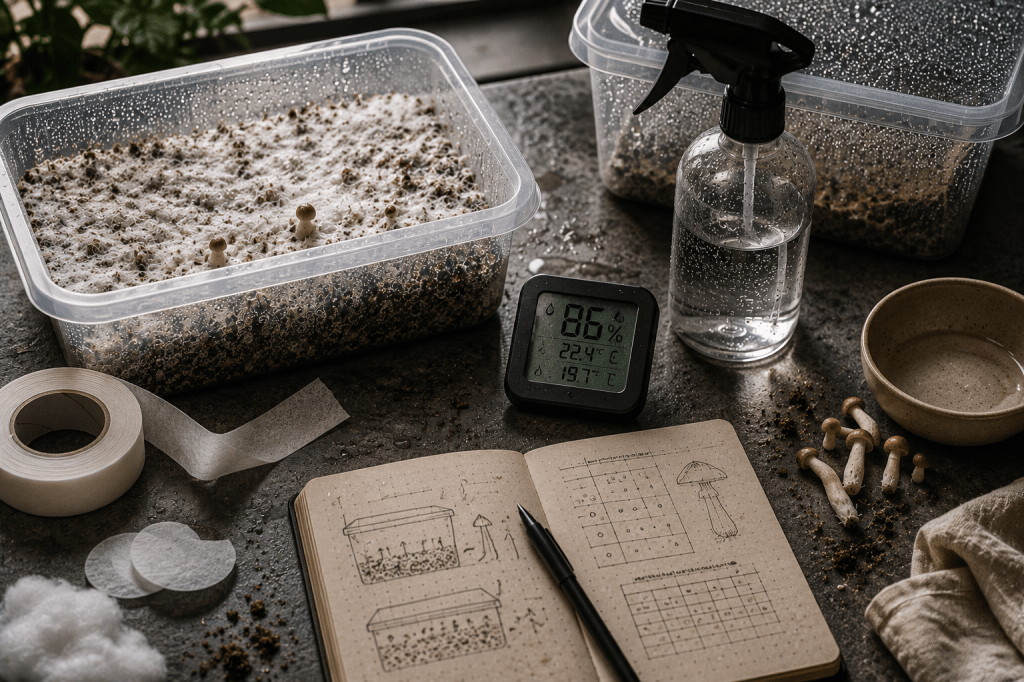
Mist the chamber walls, not the substrate. Manual misting is the primary intervention available without a humidifier. The technique that most consistently produces good outcomes is misting the inner walls and lid of the fruiting chamber rather than the substrate surface directly. This adds moisture to the air and maintains surface humidity without saturating the substrate.
Misting directly onto the substrate surface repeatedly creates conditions for bacterial contamination — particularly bacterial blotch — on maturing fruiting bodies. The substrate is best maintained at field capacity through initial preparation rather than ongoing surface wetting.
Use perlite as a moisture buffer. A 2–3cm layer of water-saturated perlite in the base of a fruiting chamber adds surface area for evaporation without requiring active management. Perlite is inexpensive, reusable, and effective. For cultivators running multiple fruiting chambers without active equipment, this is among the more practical additions.
Measuring humidity without a digital hygrometer
Digital hygrometers are inexpensive enough that using one is simply better than estimating. Instruments with ±3% accuracy are available for under €10 and remove the need for guesswork. A hygrometer placed inside the fruiting chamber gives direct readings of the environment the fruiting bodies are experiencing.
More on selecting and calibrating hygrometers for cultivation use in our hygrometer guide.
For cultivators who do not yet have a hygrometer, proxy indicators include:
Condensation pattern: Light condensation on the interior walls of a sealed or semi-sealed container indicates high relative humidity — typically above 85%. Heavy, continuous condensation dripping onto the substrate surface may indicate excessive moisture accumulation; moderate condensation that evaporates during ventilation intervals is generally favourable.
Cap surface condition: Drying or cracking of developing caps, particularly at the edges, indicates humidity has dropped below the target range. This symptom typically appears before visible quality loss if addressed promptly.
When active humidification becomes relevant
For the majority of small-scale fruiting setups — a single monotub, a fruiting box, or a few small blocks — passive humidity management is adequate. The substrate provides sufficient moisture; the container retains it; manual misting compensates for what ventilation removes.
Active humidification becomes useful or necessary in specific situations:
High-airflow setups. Martha tent configurations running fans continuously move enough air to deplete substrate-sourced humidity faster than it can be replaced. These setups benefit from active humidification to compensate.
Multiple blocks fruiting simultaneously. Running a large number of fruiting bodies at once, particularly in an open environment rather than individual closed containers, can require active moisture addition to maintain target humidity across the full fruiting area.
Low-ambient-humidity environments. In dry climates or during winter heating seasons, ambient humidity outside the fruiting chamber may be low enough that even a semi-closed container struggles to retain moisture.
Species with narrow humidity tolerances. Lion’s mane (Hericium erinaceus) is frequently cited as requiring more precise humidity management than many other species. The characteristic icicle-like teeth development is sensitive to humidity drops, and the fruiting body’s high surface-area-to-mass ratio makes it more susceptible to desiccation. Active humidification is worth considering for this species in non-humid environments.
Field capacity: the foundation
All passive humidity management depends on substrate moisture being correct from the outset. A substrate prepared at incorrect field capacity — too dry or too wet — will produce humidity problems that cannot be effectively managed after the fact.
Field capacity describes the moisture level at which a substrate holds water without excess draining or pooling. The standard test: a handful of prepared substrate, squeezed firmly, should release only a few drops of water. If water streams out freely, the substrate is too wet. If no water is released, it is likely too dry.
Over-wet substrate creates conditions for anaerobic bacteria and competes with gas exchange at the surface. Under-wet substrate depletes moisture quickly during fruiting, requiring frequent intervention and often producing lower yields before substrate exhaustion.
Getting field capacity right at preparation reduces the variables requiring active management during fruiting significantly.
Summary
Humidity management in small-scale fruiting environments is primarily a substrate and container management problem, not an equipment problem. Substrate prepared at correct field capacity, held in a closed or semi-closed container, produces and maintains the humidity environment that most cultivated species require.
Manual misting — targeted at chamber walls rather than substrate surfaces — is sufficient supplementation for most setups. Perlite buffering adds passive stability. A basic hygrometer confirms that the environment is within target range.
Active humidification addresses situations where passive management cannot keep pace with moisture loss: high-airflow setups, large-scale operations, or particularly sensitive species. For the majority of cultivators running one or a few containers, it is optional rather than essential.


Leave a comment