

Humidity is the single most commonly mismanaged variable in indoor mushroom cultivation. Most beginners mist on a schedule, estimate by feel, and adjust based on how the substrate looks. The result is a system operating blind — humidity swings that cause pinning failures, surface contamination, and aborts that get attributed to bad luck or genetics.
A calibrated hygrometer doesn’t fix these problems on its own. But it removes the guesswork from a variable that is genuinely measurable and controllable. This guide covers what to look for in a hygrometer for cultivation use, where cheaper sensors fail, and which specific options make sense across different setup scales.
Why accuracy ratings matter more than price
Most hygrometers sold under €15 advertise ±3–5% RH accuracy. In a fruiting chamber targeting 88–92% RH, that means a displayed reading of 90% could reflect an actual environment anywhere from 85% to 95%. That’s the difference between healthy primordia development and the onset of bacterial blotch.
The high-humidity range that mushroom cultivation requires — 85–95% RH — is also outside the calibrated range of many budget sensors. Hardware store hygrometers are typically rated for 30–70% RH. They drift significantly over weeks of exposure to fruiting chamber conditions, and the drift is not consistent or predictable.
Key specs to evaluate before buying:
Accuracy: Look for ±2% RH or better for cultivation use. Sensors rated ±3% are workable for monitoring trends; sensors rated ±5% introduce too much uncertainty at the margins of the target range.
RH operating range: Confirm the sensor is rated to operate accurately at high humidity. Some lower-cost sensors specify accuracy only up to 85% RH — they still display a number above that threshold, but the number is unreliable.
Response time: How quickly the sensor updates when humidity changes. Most sensors update every 10–60 seconds. Faster response is more useful for active management; slower response is adequate for monitoring stable environments.
Data logging: Logging models record timestamped readings over hours or days. This is substantially more useful for diagnosing environmental instability than a single current reading — humidity dips at 3am are invisible without a log.
Sensor calibration and field verification
No hygrometer should be trusted out of the box without verification. The standard field method: place two sensors in the same closed environment for 30 minutes. If they agree within ±2%, both are within spec. If they diverge by more than 3%, at least one is off — run the test with a third sensor to identify which.
A saturated sodium chloride salt solution produces 75% RH at equilibrium at room temperature — a useful fixed reference point for calibration. Detailed calibration procedure and a printable reference card are in the cultivation calibration sheet.
For setups running multiple fruiting chambers, calibration across sensors matters: if one sensor reads 3% higher than another, the environmental management decisions for each chamber are based on incomparable data.
Entry-level options (under €20)
Govee H5075 — consistently performs within ±3% in independent testing at high humidity. Bluetooth connectivity, 20-day app logging with min/max records. Widely available across Europe. Around €12–15. The most commonly recommended entry-level option for cultivation use.
Inkbird IBS-TH2 — Bluetooth-enabled, Home Assistant compatible for those running home automation. Slightly lower accuracy consistency than Govee at high RH in independent comparisons, but adequate for single-container setups. Around €8–12.
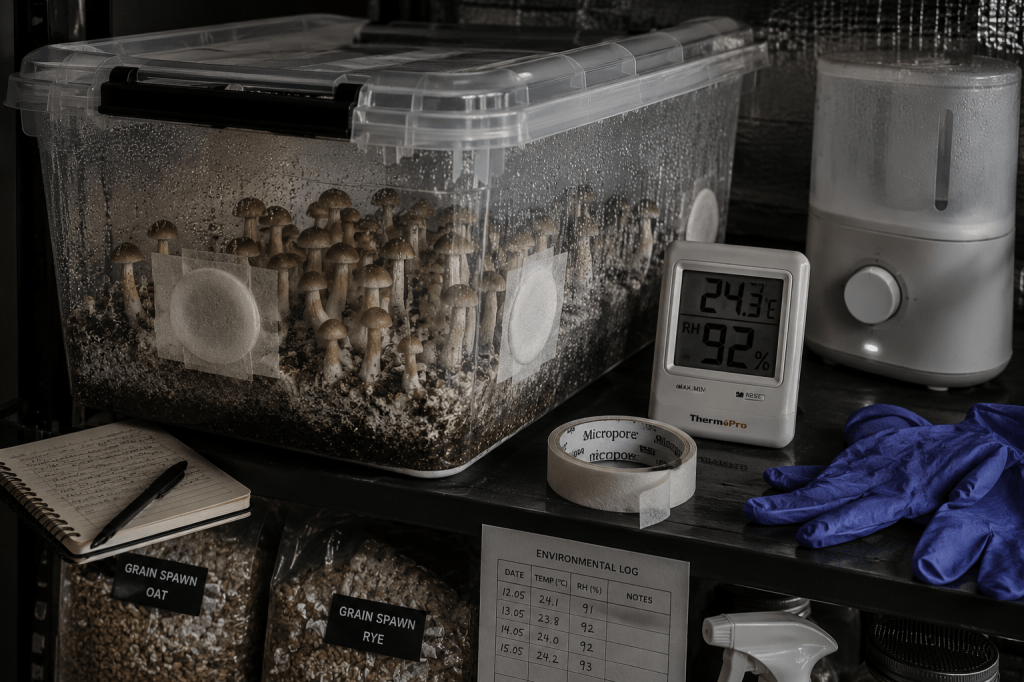
ThermoPro TP49 — basic standalone, no wireless, displays current/min/max. No app required. ±3% RH rated accuracy. Around €8–10. Suitable as a second sensor for cross-verification or for cultivators who do not want app dependency.
Mid-range: logging and higher accuracy (€20–60)
ThermoPro TP357 — ±2% RH rating, large backlit display, magnetic back for container mounting. Around €20. The clearest step up from entry-level for cultivators who do not need wireless connectivity.
Govee H5179 — WiFi connectivity without a gateway, app alerts when RH drops below a set threshold. Useful for tent setups where passive monitoring is impractical. Around €25–35.
SensorPush HT1 — performs closer to ±2% RH across the full high-humidity range in independent testing. Bluetooth with optional WiFi gateway. 20-day logging at 1-minute intervals, CSV export. Around €45–55. The most analytically useful option in this price range for cultivators who want to diagnose instability patterns.
Which hygrometer for which setup
| Setup | Recommended | Why |
|---|---|---|
| Single tub, no logging needed | ThermoPro TP49 | Reliable baseline, no app required |
| Single tub, want logging | Govee H5075 | Bluetooth + app logging at low cost |
| Multi-tub or tent, remote alerts | Govee H5179 | WiFi alerts, no gateway needed |
| Serious setup, data analysis | SensorPush HT1 | Best accuracy + CSV export in mid range |
Placement and interpretation
Where the sensor is placed determines what it measures. A sensor mounted on the wall of a fruiting chamber reports wall-level humidity, which may differ from humidity at the substrate surface by several percentage points depending on airflow and temperature gradients.
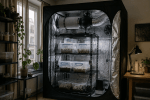
For most monotub setups, placing the sensor at mid-height inside the container gives a representative reading. For grow tent setups running multiple blocks, a second sensor at fruiting block height confirms the environment where it matters — the controller sensor mounted higher may not reflect conditions at block level if circulation is uneven. This is covered in more detail in the grow tent airflow setup guide.
Hygrometer readings are most useful interpreted alongside airflow behaviour. A reading of 87% in a setup running continuous exhaust has a different implication than 87% in a passive monotub — in the first case, the system may be losing humidity faster than it can be restored; in the second, 87% may represent equilibrium. The relationship between humidity and airflow is discussed in the fruiting chamber humidity loss diagnostic and the passive humidity management guide.
Frequently asked questions
What humidity level should I target for mushroom fruiting?
Most commonly cultivated species require 85–95% RH during fruiting. Below 80%, primordia development slows significantly. Above 98% with inadequate airflow, surface condensation accumulates and creates conditions for bacterial contamination. Species-specific tolerances vary — lion’s mane is particularly sensitive to humidity drops during fruiting body development.
How do I know if my hygrometer is accurate?
Cross-reference two sensors in the same environment for 30 minutes. If they agree within ±2%, both are within spec. The saturated salt calibration method (sodium chloride = 75% RH at equilibrium) provides a fixed reference point. Full procedure in the calibration sheet.
Do I need a hygrometer with data logging?
For diagnosing instability, yes. A current reading tells you the environment now; a log tells you what happened between checks. If fruiting performance is inconsistent and the current reading looks fine, a humidity log often reveals the cause — drops during ventilation cycles, overnight desiccation, or post-harvest recovery failure.


Leave a comment