

When a fruiting attempt fails, most growers look first at temperature, then substrate quality, then contamination. Airflow is usually the last variable examined — if it’s examined at all.
This ordering is understandable. Airflow is invisible. Its effects unfold slowly. And the symptoms it produces — stalled pins, aborted primordia, dense mycelium that won’t fruit — closely resemble the symptoms of other problems.
But across a range of cultivation setups, inadequate gas exchange is one of the most consistent failure points in fruiting. Understanding why requires looking briefly at what mushrooms are actually doing when they form.
What mushrooms need from the atmosphere
Mycelium and developing fruiting bodies have different atmospheric requirements. During colonisation, the fungal network is metabolically active but relatively tolerant of elevated CO₂ levels. Some cultivators deliberately retain higher CO₂ during colonisation to suppress primordia formation until a substrate is fully run.
Fruiting changes this relationship. Once a colonised block or monotub is exposed to fruiting conditions, the fungal system begins responding to environmental cues — light, temperature drop, and critically, a reduction in CO₂ concentration.
Elevated CO₂ signals to the mycelium that it is still buried, still subterranean, still in an environment where fruiting would be premature. Falling CO₂ signals exposure. From the organism’s perspective, exposure means an opportunity to sporulate.
This is why airflow matters: it physically removes CO₂ from the fruiting environment and allows the organism to respond accordingly.
What happens when CO₂ stays elevated
CO₂ above approximately 1,000–2,000 ppm consistently produces observable effects on fruiting body morphology and behaviour. Specific thresholds vary by species, but the general pattern is well documented.
Pin formation is suppressed or delayed. The mycelium receives no trigger to initiate primordia. A colonised block may sit in fruiting conditions for two or three weeks without pinning, while appearing otherwise healthy.
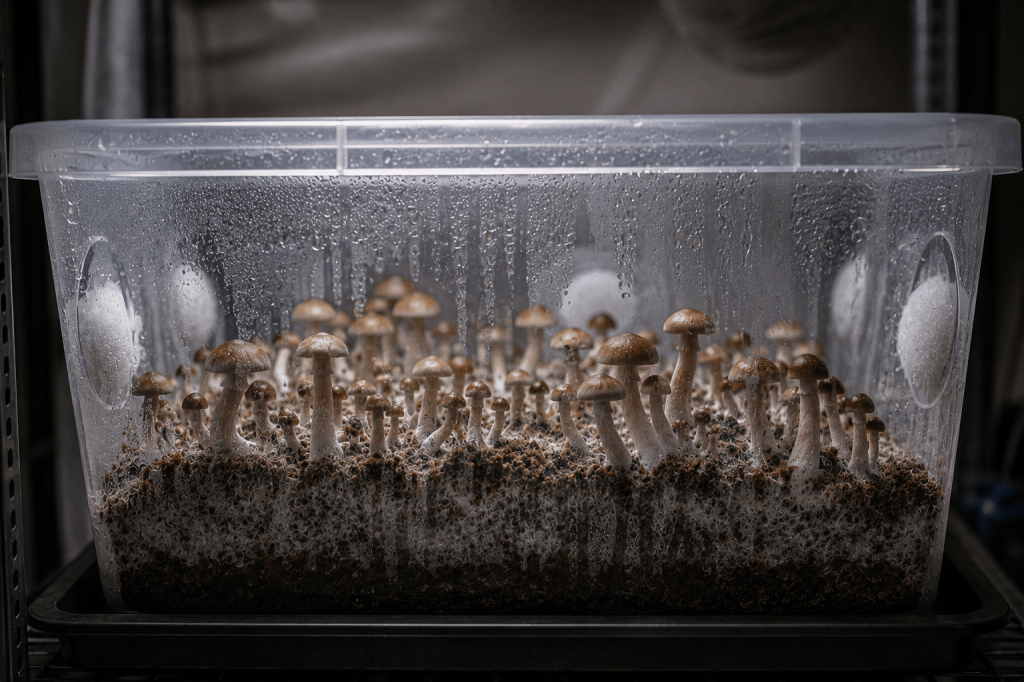
Pins that do form show abnormal morphology. Long, thin stems with small, underdeveloped caps — sometimes called “leggy” fruiting bodies — are characteristic of high-CO₂ environments. The organism elongates in an attempt to reach atmospheric conditions with lower CO₂ concentrations, a growth pattern visible in naturally occurring fungi emerging through soil.
Abortions increase. Pins that initiate may abort before maturity, particularly if CO₂ fluctuates rather than remaining consistently low. Aborted pins appear as small, darkened, dense masses that stop developing and eventually dry in place.
Yield is suppressed. Even where fruiting does occur, inadequate gas exchange generally reduces total yield per flush and reduces the number of flushes before the block exhausts.
CO₂ sources in a fruiting environment
Understanding where CO₂ comes from helps in managing it. In a sealed or semi-sealed fruiting chamber, CO₂ accumulates from two sources.
Fungal metabolism. Actively growing mycelium and developing fruiting bodies both respire, consuming oxygen and releasing CO₂. A fully colonised substrate block produces measurable CO₂ continuously during active growth phases.
Microbial activity in the substrate. Pasteurised or partially sterilised substrates contain background microbial communities that also respire. In bulk substrates — straw, wood chips, coco coir — this contribution can be significant.
In a sealed fruiting chamber with no ventilation, CO₂ from these sources accumulates rapidly. Within a few hours, concentrations can reach levels that inhibit pinning.
How to assess airflow in your setup
Most small-scale cultivators do not have access to CO₂ meters, though these instruments have become inexpensive enough that they are worth considering for anyone running consistent setups. A basic NDIR CO₂ sensor accurate to ±50 ppm costs well under €50 and removes guesswork from the equation.
Without a meter, assessment relies on indirect indicators.
Pin morphology is the most reliable proxy. Long, thin-stemmed fruiting bodies with underdeveloped caps suggest CO₂ is too high during development. Healthy fruiting bodies should show proportionate stem-to-cap ratios appropriate for the species.
Pinning delay relative to expected timelines is another indicator. If a substrate that typically pins within 5–7 days of fruiting initiation consistently takes 14 or more days, gas exchange is a reasonable suspect after other variables have been ruled out.
The balance with humidity
A persistent challenge in fruiting chamber design is that airflow and humidity work in opposition. Airflow removes CO₂ effectively but also removes moisture from the air, lowering relative humidity. Humidity maintenance typically involves reducing air movement, which allows CO₂ to build.
This tension does not have a universal solution. Different cultivation formats resolve it differently.
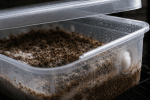
Monotubs with passive holes rely on pressure differentials and natural convection to exchange air slowly while retaining humidity through substrate moisture and the microclimate within the tub. The design works but requires careful calibration of hole placement and polyfill quantity.
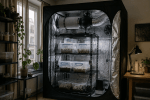
Martha tent setups with ultrasonic humidifiers and fans run near-continuous airflow while compensating for humidity loss with active moisture addition. This decouples the two variables but introduces equipment complexity and the risk of over-saturation.
Shotgun fruiting chambers (SFGCs) — four-sided perlite-lined boxes with holes on all sides — move a large volume of air but struggle to maintain high humidity without misting. They are effective for gas exchange but require frequent intervention to maintain the moisture environment most species require.
Ventilation frequency and technique
For cultivators managing ventilation manually — fanning a monotub or fruiting box several times per day — frequency and technique both matter.
Frequency: Most cultivators working with gourmet species in similar conditions find that 2–4 ventilation intervals per day is sufficient during early pinning. During rapid fruiting body development, more frequent exchange may accelerate growth. During the period between flushes when substrate is resting, ventilation needs decrease.
Technique: The goal is to exchange the air volume within the fruiting chamber, not simply to create turbulence at the surface. In a monotub, this means fanning until the interior air — including the dead zones at the corners — has been replaced. Ten to fifteen seconds of active fanning is typically sufficient for a standard 66-litre tub.
Species differences
Not all cultivated species have identical CO₂ tolerance. This variation is worth noting because cultivation advice is often written with a single species in mind.
Oyster mushrooms (Pleurotus spp.) are generally considered more sensitive to CO₂ than many other commonly cultivated species. They abort readily and show strong morphological responses to elevated gas levels. Growers working with oysters typically err on the side of more aggressive ventilation.
King oysters (Pleurotus eryngii) and lion’s mane (Hericium erinaceus) are often cited as particularly responsive to gas exchange conditions. Lion’s mane in particular shows clear visual differences between well-ventilated and poorly ventilated conditions — the characteristic “teeth” development is suppressed in high-CO₂ environments, producing a smooth, undifferentiated mass instead.
Shiitake (Lentinula edodes) has somewhat higher CO₂ tolerance than oysters, particularly during early colonisation, but still benefits from consistent fresh air exchange during fruiting.
Practical adjustments
For cultivators experiencing the symptoms described above, the intervention protocol is straightforward.
Increase air exchange first. If running a passive system, increase hole size or polyfill permeability. If running a manual ventilation routine, increase frequency. If running active ventilation, adjust fan cycling or speed.
Monitor the response over 3–5 days. Fruiting body morphology should improve within a flush if CO₂ was the primary variable. Pin initiation should accelerate and cap development should normalise.
If increasing airflow creates humidity loss that the system cannot compensate for, address humidity separately rather than restricting airflow to retain moisture. The two variables require independent management. Linking them — reducing airflow to save humidity — consistently produces worse outcomes than managing each directly.
Summary
Airflow in fruiting environments is not a secondary consideration. CO₂ accumulation suppresses pinning, distorts fruiting body morphology, and reduces yield across a range of cultivated species. The physiological basis for this is straightforward: the organism uses atmospheric CO₂ as a signal for its developmental state.
Managing gas exchange requires understanding the balance between CO₂ removal and humidity retention. These variables are in tension in most small-scale setups, and resolving that tension — through system design rather than compromise — is one of the more meaningful optimisations available to the cultivator.
Understanding contamination alongside airflow gives a more complete picture of fruiting chamber management. Inadequate gas exchange and contamination pressure often occur together: stalled, stressed pins in a high-CO₂ environment are more vulnerable to bacterial and fungal contamination than healthy, developing fruiting bodies in a well-ventilated chamber. More on contamination identification in our mushroom contamination identification guide.


Leave a comment