




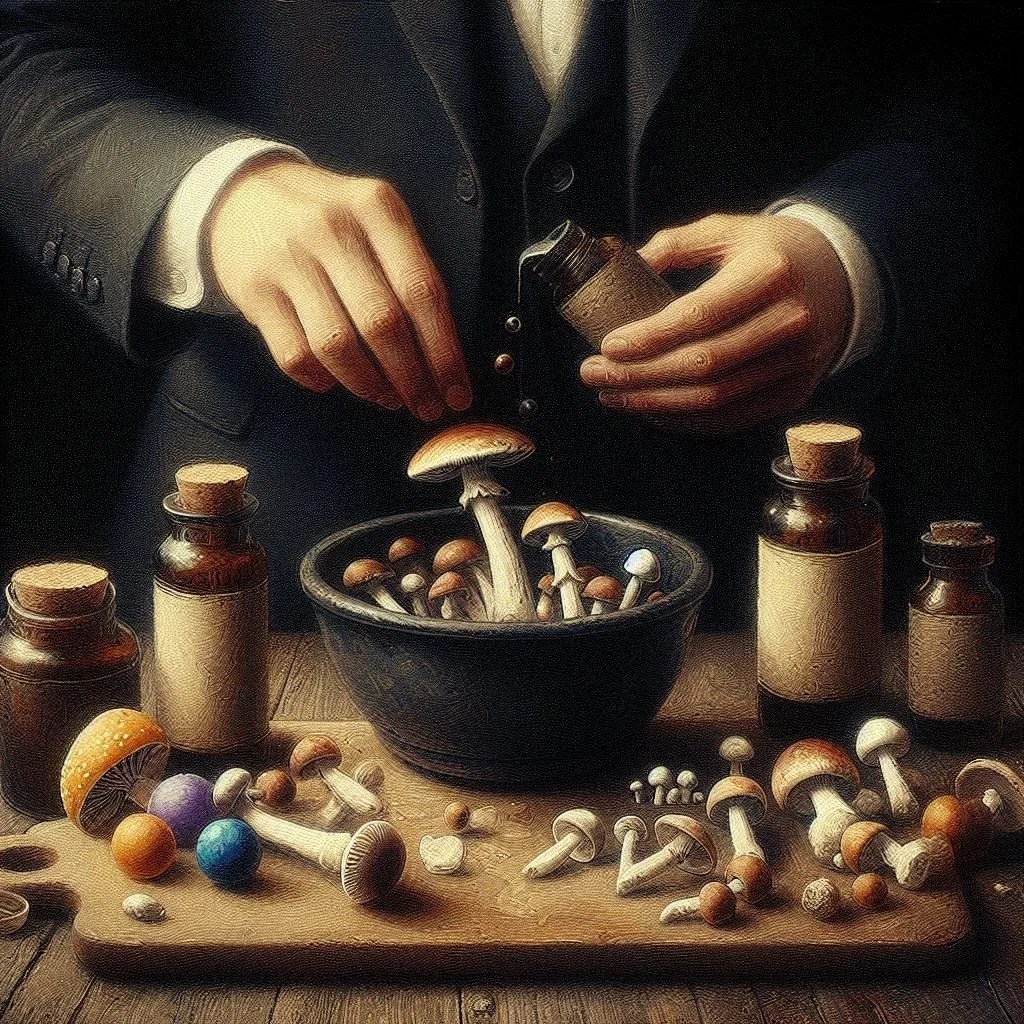
Over the past decade, the practice of consuming sub-perceptual quantities of psilocybin — commonly referred to as microdosing — has moved from fringe online communities into wellness media, startup culture, and mainstream public discourse. In Europe, this shift has been particularly visible in cities with established biohacker, tech, and alternative wellness communities: Amsterdam, Berlin, Copenhagen, and Zurich have all seen notable growth in microdosing discussions, retreats, and semi-underground communities.
This piece examines how the microdosing trend developed, what drives its appeal, how it has intersected with European wellness culture, and why it remains scientifically and legally contested.
From Underground Practitioner Reports to Mainstream Media
The modern microdosing trend can be traced in large part to James Fadiman, an American psychologist who began collecting self-report data from microdosers in the early 2010s and published The Psychedelic Explorer’s Guide in 2011. Fadiman’s systematisation of practitioner reports — compiled through an informal research protocol rather than a clinical trial — provided the first organised body of anecdotal evidence and attracted significant media attention.
By 2015–2016, microdosing had become a documented trend in Silicon Valley, reported in publications including Rolling Stone, Forbes, and the New Yorker. The framing in US tech culture was primarily productivity-oriented: microdosing as a tool for enhanced focus, creativity, and problem-solving. This framing influenced how the practice was subsequently discussed in European contexts, though European adoption tended to blend productivity and wellness angles more closely than the US tech narrative alone.
The European Biohacker Context
Biohacking — the practice of using self-experimentation, nutritional supplementation, behavioural protocols, and emerging biotechnology to optimise physical and cognitive performance — has established communities in several European cities. Scandinavian countries in particular have an active biohacking scene, with communities in Stockholm and Helsinki organising regular meetups and experimentation groups.
Within these communities, microdosing became one of several experimental cognitive enhancement strategies discussed alongside nootropics, intermittent fasting, sleep optimisation protocols, and wearable monitoring technology. The biohacker framing was notably different from both the therapeutic framing of clinical research and the spiritual framing of traditional psychedelic use: it treated microdosing as a performance variable to be tracked and optimised rather than as a therapeutic intervention or spiritual practice.
This quantification orientation — tracking mood scores, productivity metrics, sleep quality, and HRV data alongside microdosing schedules — represented a distinct cultural adaptation of psychedelic practice. It also generated more structured self-report data than purely anecdotal accounts, though this data remained uncontrolled and difficult to compare across individuals.
The Wellness Industry Integration
Parallel to the biohacker community, microdosing became integrated into European wellness culture through a different pathway: mental health and burnout recovery. In countries with high rates of workplace burnout — particularly the Netherlands, Germany, and the UK — microdosing appeared in wellness media as a potential tool for managing stress, improving emotional regulation, and recovering from burnout.
Dutch retreat operators in particular developed a market segment around supervised psilocybin truffle experiences (legal in the Netherlands) combined with therapeutic support, meditation, and integration coaching. These retreats attracted participants from across Europe, many of whom were seeking alternatives to pharmaceutical approaches to anxiety and depression.
The wellness framing positioned microdosing within an existing cultural vocabulary — self-care, mindfulness, somatic work, integrative health — that had already been normalised in European wellness consumer markets. This framing was arguably more culturally legible to a mainstream European audience than the productivity-focused tech narrative.
The Scientific Evidence Base: What It Actually Shows
Despite significant public interest, the scientific evidence base for microdosing remains limited and contested. The methodological challenges are considerable: microdosing research is difficult to conduct under proper controlled conditions because participants can often detect whether they have received an active dose, compromising blinding; self-selection into microdosing research skews toward individuals who already believe in its benefits; and the optimal dose for sub-perceptual effects varies significantly between individuals.
A 2021 study by Szigeti et al., published in eLife, used a self-blinded citizen science design to compare microdosing to placebo. The study found improvements in psychological wellbeing and perceived cognitive functioning, but also found that the improvements were largely attributable to expectation effects — participants who believed they were taking an active dose reported benefits regardless of whether they actually received one. The authors concluded that expectancy, rather than pharmacological activity, may account for a significant proportion of self-reported microdosing benefits.
A 2022 double-blind placebo-controlled trial by Szigeti and colleagues at Imperial College London found modest positive effects on mood and wellbeing in some measures but did not find significant cognitive enhancement effects. Larger, more rigorous trials are ongoing at several institutions.
The placebo debate does not necessarily invalidate microdosing as a practice for individuals who find it helpful — placebo effects can produce genuine subjective improvements — but it does complicate claims about specific pharmacological mechanisms and challenges the confident performance-enhancement narrative that drove early cultural adoption.
Regulatory Differences Across Europe
European regulatory frameworks for psilocybin vary considerably, creating a patchwork of legal environments that shapes where and how microdosing culture develops.
The Netherlands occupies a unique position: psilocybin-containing truffles (Psilocybe tampanensis and related species) were not included in the 1976 drug scheduling that criminalised mushrooms, and remain legally available for purchase and consumption. This has made the Netherlands the de facto centre of legal psilocybin access in Europe, supporting a substantial truffle retail market and a growing retreat industry.
In the Czech Republic, possession of small quantities of psychedelic substances is decriminalised, though not legally permitted. In Germany, psilocybin was rescheduled in 2024 to permit its use in controlled clinical research settings, though recreational or personal use remains prohibited. Switzerland has permitted psilocybin research under compassionate use frameworks, with several institutions conducting or planning trials.
The UK maintains one of the stricter regulatory positions in Europe, with psilocybin classified as a Class A controlled substance and no legal pathway for non-clinical access. This has not prevented the development of a microdosing community in the UK, but has limited the ability of that community to organise publicly or commercially.
Media Coverage and Cultural Saturation
By 2022–2023, microdosing had received coverage in major European publications including Der Spiegel, Le Monde, The Guardian, and NRC Handelsblad, among others. The tone of coverage shifted noticeably over this period: early coverage was predominantly novelty-focused and sometimes credulous; later coverage increasingly engaged with the scientific uncertainty, the placebo debate, and the regulatory complexity.
Podcasts became a significant distribution channel for microdosing discourse in Europe, with several Dutch, German, and Scandinavian podcasts dedicated to psychedelic culture and microdosing specifically building substantial audiences. This podcasting ecosystem served as an information layer operating largely outside mainstream media, where more detailed and practically-oriented discussion occurred.
Social media played a dual role: Instagram and TikTok content promoted microdosing in wellness aesthetics, while Reddit communities (particularly r/microdosing, which has over 200,000 members) provided a more mixed and critically-engaged discussion environment where negative experiences, protocol failures, and research limitations were regularly discussed alongside positive reports.
The Microdosing Industry and Commercial Interests
Alongside the cultural trend, a commercial ecosystem has emerged. In the Netherlands, truffle retailers market their products explicitly to microdosers, with product lines tailored to sub-perceptual dosing and integration guides included with purchases. Coaching and consulting services have emerged across several European countries, offering microdosing guidance, integration support, and community access for monthly fees.
This commercialisation has generated criticism from both research-oriented and harm-reduction communities. The concern is that commercial framing reinforces benefit narratives while systematically de-emphasising contraindications, adverse effects, and the uncertainty of the evidence base. Individuals with personal or family histories of psychosis, certain medication interactions (particularly SSRIs, which interact with psilocybin’s serotonergic mechanism), and other risk factors may not receive adequate information in commercial microdosing contexts.
Where the Trend Stands Now
Microdosing occupies an unusual position in 2025: it is culturally mainstream in the sense that most informed Europeans have heard of it and can identify its basic premise, but it remains scientifically underdetermined and legally irregular across most of the continent. The gap between cultural saturation and evidentiary certainty is larger than popular coverage typically acknowledges.
The next several years of clinical research — including ongoing trials at Imperial College London, Johns Hopkins, and several European institutions — will likely clarify which aspects of the reported benefits are pharmacologically reliable versus expectancy-driven, and will inform regulatory discussions currently underway in Switzerland, Germany, and the UK.
For now, the microdosing trend is best understood as a cultural phenomenon shaped by the convergence of biohacker optimisation culture, wellness industry framing, loosening public attitudes toward psychedelics, and a genuine (if still early-stage) scientific research programme. Its durability will depend significantly on how that research programme develops over the next decade.
Continue Reading
- The Cultural and Scientific History of Psilocybin Research
- What Current Research Suggests About Psilocybin, Meditation, and Cognitive Flexibility
Weekly Fungal Systems Briefing
Join the weekly fungal systems briefing for European research updates, cultivation systems, and mushroom culture analysis.

