

Indoor mushroom cultivation is a systems problem. The species being grown, the substrate it colonises, the container it fruits in, and the environment surrounding all of that — temperature, humidity, airflow, light — function as an interconnected system. When any variable drifts outside its acceptable range, the entire system responds. Understanding cultivation this way from the start produces better outcomes than following step-by-step instructions disconnected from the underlying principles.
This article covers the foundational elements of a beginner indoor cultivation environment: what to control, how to monitor it, what equipment is necessary versus optional, and where most setups fail.
The Cultivation Environment: What You’re Actually Managing
Indoor cultivation creates an artificial growing environment that must substitute for the ecological conditions a species evolved in. Each species has characteristic requirements — temperature ranges, humidity preferences, substrate composition, light exposure — derived from the habitats it naturally occupies. A cultivation setup that doesn’t meet these requirements will fail, regardless of technique quality or substrate quality.
For most beginner-accessible cultivated species, the key environmental parameters are:
- Substrate temperature during colonisation: 22–26°C for most species
- Ambient temperature during fruiting: 18–24°C (species-dependent)
- Relative humidity during fruiting: 85–95%
- Fresh air exchange (FAE): Sufficient to prevent CO₂ accumulation above 1,000–2,000 ppm
- Light: Indirect ambient light for directional cue; most species do not require high-intensity lighting
These are target ranges, not fixed values. Actual conditions need to stay within these ranges consistently — which requires measurement, not assumption.
Contamination: The Dominant Failure Mode
Contamination — the growth of competing organisms (bacteria, moulds) on the substrate before or during fruiting — is responsible for the majority of beginner failures. It is also the most preventable category of failure, given adequate understanding of the sources.
Contamination occurs when competing organisms reach the substrate in sufficient quantity to outcompete or damage the mycelium. Sources include airborne spores, unsterilised substrate, unsterilised tools, contaminated hands or gloves, breath, and previously contaminated equipment that was not properly cleaned.
Sterile Environment Principles
A sterile workflow does not require a laboratory. It requires consistent application of a small number of practices: surface disinfection with 70% isopropyl alcohol, glove use, limiting open-air exposure time during inoculation, and proper sterilisation of substrate before inoculation. Each practice addresses a specific contamination vector. Skipping any one of them re-introduces that vector.
A still-air box (SAB) — a large clear container with arm holes cut into the sides, which allows work in a low-airflow environment — is a cost-effective solution for reducing airborne contamination during inoculation without the expense of a laminar flow hood.
Substrate and Sterilisation
Substrate is the growth medium — the material the mycelium colonises before fruiting. For most beginner-accessible species, common substrate components include grain (rye, wheat, oats, popcorn), brown rice flour mixed with vermiculite (BRF/verm), or bulk coir-based mixes for fruiting blocks.
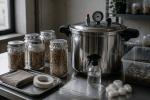
All grain-based substrates must be sterilised before inoculation. Pressure cooking at 15 PSI / 121°C for 90–120 minutes eliminates heat-resistant spores and bacteria that survive boiling. A pressure cooker rated to 15 PSI is the essential piece of equipment for grain-based substrate preparation. Alternatives exist (pasteurisation for coir-based substrates, which have a lower contamination risk profile) but grain sterilisation requires pressure.
Substrate water content (field capacity) affects colonisation speed and contamination risk. Too wet: anaerobic conditions favour bacterial contamination. Too dry: colonisation slows and stalls. Field capacity is typically tested by the squeeze test — a handful of prepared substrate squeezed firmly should release only a few drops of water.
Fruiting Chamber Design
The fruiting chamber is the environment in which colonised substrate is induced to produce fruiting bodies. Its design determines how well humidity, airflow, and temperature can be managed. For beginners, the most common approaches are:
Monotub
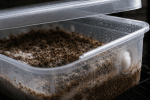
A large polypropylene storage container (typically 15–50L) with holes drilled in the sides and lid for passive fresh air exchange (FAE). The holes are stuffed with polyfill or filter material to allow gas exchange while limiting airborne contamination entry. The monotub is placed in an ambient-temperature room, and humidity is maintained by misting. This is the most common beginner setup and scales well to multiple grows.
Shotgun Fruiting Chamber (SGFC)
A clear container perforated on all six sides with small holes (typically 6mm on a 2-inch grid pattern), with perlite at the base for passive humidity. The SGFC provides good airflow but requires more active management of humidity since its passive exchange rate is high. Better suited to environments with naturally higher ambient RH.
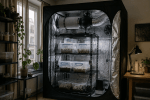
Martha Tent or Grow Tent
A small greenhouse-style tent (common sizes 60×60×140cm to 120×60×180cm) with an ultrasonic humidifier connected to a hygrostat controller, which maintains target RH automatically. This setup requires more equipment investment but significantly reduces active maintenance. It scales to multi-block grows and provides more consistent environmental control than passive approaches.
Humidity Management
Fruiting humidity requirements (85–95% RH) are significantly higher than typical indoor ambient humidity in most European regions, which ranges from 35–60% in centrally-heated spaces. This gap must be actively bridged by the fruiting chamber design.
Manual misting with a clean spray bottle is adequate for single-tub setups: misting 2–3 times daily onto the chamber walls (not directly onto the substrate surface) introduces enough moisture to maintain target RH in a well-sealed monotub. For larger setups or environments with very low ambient humidity, an ultrasonic humidifier connected to a digital hygrostat controller automates this process.
Measurement is essential. A digital hygrometer placed inside the fruiting chamber provides accurate readings and reveals whether misting frequency is maintaining target RH or falling short. Estimating by feel is insufficient for consistent results.
Airflow and CO₂ Management
Mushrooms produce CO₂ as a byproduct of respiration. In a sealed environment, CO₂ accumulates and suppresses normal fruiting body development — producing elongated, thin-stemmed growth with underdeveloped caps. Fresh air exchange removes accumulated CO₂ and introduces oxygen.
In a monotub with passive FAE holes, gas exchange occurs naturally through the filter patches. In a sealed container, manual fanning is required: opening the lid and fanning gently 2–3 times daily for 10–15 seconds refreshes the atmosphere without causing significant humidity loss.
The tension in fruiting chamber design is between maintaining humidity (which favours sealed environments) and maintaining adequate airflow (which favours open or perforated environments). Most successful beginner chamber designs address both by incorporating filter-stuffed FAE holes that allow passive gas exchange while limiting moisture loss and contamination entry.
Temperature Management
Most cultivated species colonise fastest between 22–26°C and fruit at slightly lower temperatures, typically 18–24°C. In European homes, year-round temperature consistency is uncommon — rooms often vary between 16–24°C depending on season, heating system, and room position.
For setups in cooler environments, a heat mat with thermostat controller positioned below or adjacent to the substrate provides consistent warmth without the risk of overheating. A probe thermometer placed at substrate level — not air level — is the accurate measurement point, as substrate can run several degrees cooler than ambient air in cold rooms.
Core Equipment List for a Beginner Setup
A functional single-tub beginner cultivation setup requires a modest equipment investment. The following items cover substrate preparation, sterilisation, inoculation, and fruiting environment management:
- Pressure cooker (8–15L, 15 PSI rated) — for grain substrate sterilisation
- Digital hygrometer with min/max logging — for fruiting environment monitoring
- Polypropylene monotub (15–30L) — primary fruiting chamber
- Micropore tape — for FAE hole filter patches
- Nitrile gloves (box of 100) — for sterile workflow
- 70% isopropyl alcohol — surface and tool sterilisation
- Heat mat with thermostat controller — for temperature management in cooler environments
- Clean spray bottle — dedicated to cultivation misting only
- Polyfill or filter material — for FAE hole stuffing
Optional but useful for expanding beyond a single grow: a grow tent, ultrasonic humidifier, and digital hygrostat controller allow multiple blocks to be managed simultaneously with reduced active intervention.
Where Beginner Setups Most Often Fail
Based on the most common failure patterns in beginner indoor cultivation, the following are the highest-risk points:
- Inoculation environment: Working in uncontrolled airflow or with contaminated tools during inoculation introduces contamination before colonisation begins
- Substrate sterilisation: Inadequate pressure cooking time or insufficient PSI leaves heat-resistant spores viable in grain substrate
- Humidity measurement: Assuming humidity is adequate without instrumentation leads to operating at suboptimal RH without knowing it
- FAE design: Fully sealed containers without FAE holes cause CO₂ accumulation that arrests or distorts pin development
- Temperature consistency: Night-time temperature drops in unheated rooms slow colonisation and can halt pinning, which appears as a failure but is a thermal limitation
The Case for Starting with a Grow Kit
For beginners who want to observe the fruiting process and develop observational skills before investing in the full substrate preparation workflow, a pre-colonised grow kit removes the colonisation phase entirely. It reduces equipment requirements to a fruiting chamber and misting bottle, and shifts the focus to fruiting environment management — which is, ultimately, where most of the relevant skill development occurs.
A successful kit grow develops the environmental awareness — how humidity feels at 90% versus 70%, how CO₂ accumulation affects pin morphology, how temperature shifts affect growth speed — that makes the transition to substrate-level work significantly easier.
Continue Reading
- Why Most Beginner Mushroom Grows Fail: 5 Environmental Mistakes to Avoid
- Best Beginner Mushroom Grow Kits in Europe: Environment, Ease of Use, and Setup Quality
- Indoor Mushroom Cultivation Systems: Environment, Sterility, and Monitoring Basics
Weekly Fungal Systems Briefing
Join the weekly fungal systems briefing for European cultivation updates, research summaries, and mushroom industry analysis.

