
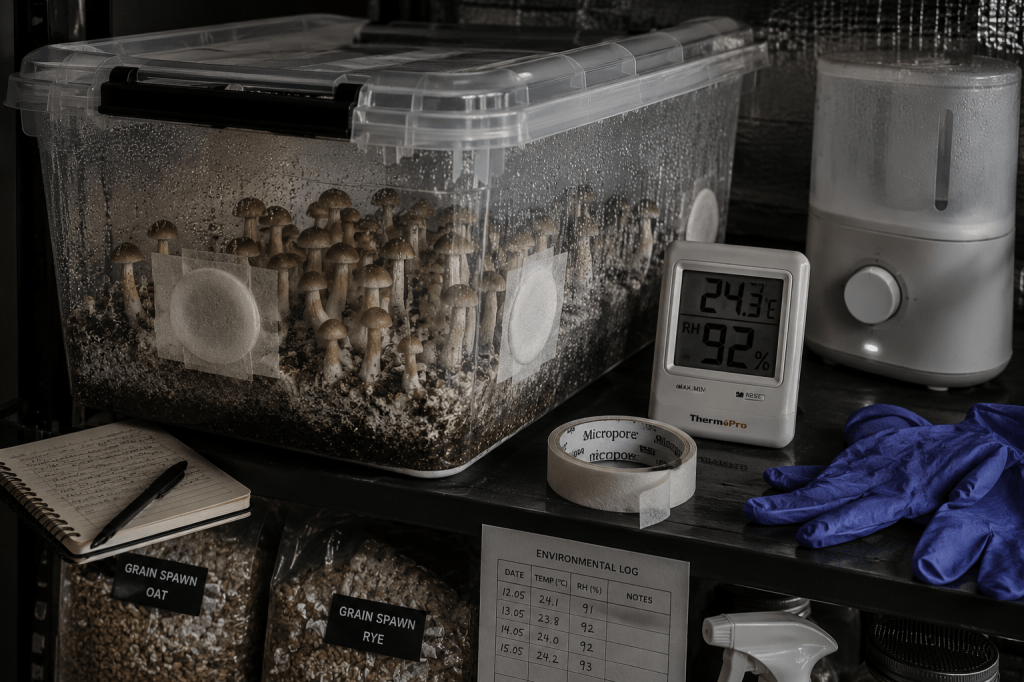
Most beginner mushroom grows fail for the same handful of reasons — and none of them are exotic. Contamination, inconsistent humidity, inadequate airflow, temperature drift, and poor sterile technique account for the overwhelming majority of failed attempts. Understanding each of these failure points as an environmental systems problem rather than a beginner’s luck problem changes how you approach indoor cultivation from the start.
This article breaks down the five most common environmental mistakes, explains the underlying mechanisms, and outlines practical corrections grounded in cultivation principles rather than guesswork.
1. Inadequate Sterile Technique — The Root of Most Contamination
Contamination is the leading cause of failure in indoor mushroom cultivation. The most common contaminants — Trichoderma, Cobweb mold, and green Penicillium species — colonise substrates faster than mycelium under conditions that favour their growth: warm, moist environments with ambient airborne spore load.
The core mistake is underestimating how many contamination sources exist in a typical household. Door openings, HVAC systems, clothing, breath, and unsterilised surfaces all introduce competing organisms. Beginners frequently focus on sterilising their substrate while neglecting the inoculation environment itself.
Sterile Workflow Checklist
- Wipe work surfaces with 70% isopropyl alcohol before and after each session
- Work near a still-air environment or inside a still-air box (SAB)
- Wear nitrile or latex gloves — change between substrate and inoculation steps
- Wear a face mask to reduce breath contamination
- Sterilise tools (scalpels, syringes, jars) before use — flame sterilise metal tools until glowing, allow to cool
- Limit session duration in open air — extended exposure increases contamination risk
- Use micropore tape over jar lids for filtered gas exchange without open air exposure
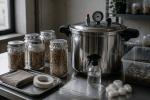
Equipment consideration: A pressure cooker rated to 15 PSI is the minimum standard for substrate sterilisation. At 15 PSI and 121°C for 90–120 minutes, most heat-resistant spores and bacteria are eliminated. Boiling alone (100°C) is insufficient — it does not reach sterilisation temperature. Sterile nitrile gloves and micropore tape are inexpensive inputs that eliminate several of the most common contamination vectors.
2. Inconsistent or Inaccurate Humidity Management
Most cultivated species require relative humidity (RH) between 85–95% during fruiting. Below 80%, primordia development slows significantly and pins may abort. Above 98% with inadequate airflow, surface condensation accumulates, creating anaerobic patches that encourage bacterial contamination.
The mistake most beginners make is estimating humidity by feel or by misting frequency alone, without measurement. Two identical-looking setups in different rooms, seasons, or with different tub sizes can have RH values that differ by 15–20 percentage points. Without a calibrated instrument, you are operating blind.
Environmental Monitoring Approach
A digital hygrometer with temperature display placed inside your fruiting environment is the minimum instrumentation for serious cultivation. Entry-level models in the €8–20 range provide accurate readings within 2–3% RH and log min/max values, which reveals humidity swings you’d otherwise miss. For multi-tub setups, dedicated data loggers with Bluetooth connectivity allow remote monitoring without opening the fruiting environment.
Misting schedules should be adjusted to maintain target RH, not to a fixed daily frequency. In winter, central heating dramatically reduces ambient RH; in summer, high ambient humidity may reduce the need for supplemental misting. Season, room, and tub design all interact. Measurement removes the uncertainty from this variable.
Equipment consideration: A heat mat with adjustable thermostat combined with a hygrometer allows you to manage both temperature and humidity as a system rather than separately — essential during colder months when substrate temperature falls below optimal range (21–26°C for most species).
3. Insufficient Airflow and CO₂ Accumulation
Mushrooms respire: they consume oxygen and produce carbon dioxide. In a sealed or near-sealed container, CO₂ accumulates rapidly. Elevated CO₂ levels above approximately 1,000–2,000 ppm (compared to ambient ~400 ppm) signal to developing fruiting bodies that conditions are subterranean — which promotes elongated, thin-stemmed growth and inhibits cap development.
In practical terms: if your mushrooms are developing long, thin stems with small or absent caps, CO₂ accumulation is a primary suspect. In a fully sealed tub with no fresh air exchange (FAE), this becomes limiting within hours of initial pinning.
Airflow System Basics
- Passive FAE: Drill 6mm holes in tub sides (4–6 holes on each side), stuffed with polyfill or polyester filter material. This creates passive gas exchange without active fans or electricity
- Fan-assisted FAE: A small USB fan positioned to indirect-flow air across (not directly onto) the substrate — reduces boundary-layer CO₂ without desiccating the surface
- Shotgun fruiting chambers (SGFC): Perforated on all six sides with perlite at the base for passive humidity; suited to single-tub beginner setups
- Frequency: For tubs without passive FAE, manually fan 2–3 times daily during fruiting — open lid, fan 10–15 seconds, close immediately
The balance between humidity retention and adequate airflow is the central technical challenge in fruiting chamber design. Solutions that address only one variable at the expense of the other tend to fail: high airflow with no humidity compensation causes pinning failure; high humidity with no airflow causes surface contamination and developmental abnormalities.
4. Temperature Drift Outside the Optimal Range
Substrate temperature — not ambient room temperature — is the variable that matters. Substrate can run 1–3°C cooler than ambient in winter or warmer when mycelium is actively metabolising. Most cultivated species have a colonisation optimum around 24–26°C and a fruiting optimum slightly cooler, around 20–24°C. Outside these bands, both colonisation speed and fruiting efficiency degrade noticeably.
In European climates, winter presents the more consistent challenge. Rooms that fall to 17–18°C at night dramatically slow mycelial growth and can arrest pinning entirely. Beginners who set up in October or November and see no activity for three weeks are often experiencing thermal limitation, not contamination or technique failure.
Equipment consideration: A heat mat positioned below a grow tub, combined with a digital thermostat controller, allows substrate temperature to be maintained within 1–2°C of target regardless of ambient room temperature. This is especially relevant in stone-floor apartments or unheated storage rooms common in northern European settings.
Monitor substrate temperature with a probe thermometer for at least 24 hours before concluding a grow is stalled — temperature, not time, governs colonisation speed.
5. Choosing the Wrong Container for Your Conditions
Tub selection is underestimated as an environmental variable. The geometry and material of your fruiting chamber influence heat retention, humidity stability, airflow dynamics, and ease of maintenance. Beginners often start with whatever container is available — which may be technically usable but environmentally suboptimal.
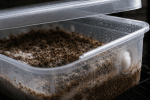
Clear-sided tubs allow light from multiple angles, which can interfere with directional pinning and make it difficult to observe the substrate interior without disturbing the environment. Opaque or semi-opaque polypropylene monotubs with drilled FAE holes are a standard solution: stable, inexpensive, and compatible with passive and active airflow approaches.
Lid design matters: airtight lids require manual FAE; lids with integrated filters provide passive exchange but may require humidity supplementation. Matching your container design to your level of active maintenance capacity — how often you can check and mist — is a practical criterion beginners rarely consider at the selection stage.
Beginner Setup Recommendations
A reliable beginner indoor setup for a single grow cycle typically requires:
- Digital hygrometer and thermometer (essential baseline instrumentation)
- Polypropylene monotub (10–20L capacity, opaque or dark-coloured)
- Micropore tape for filter patches over FAE holes
- Pressure cooker (minimum 8L, 15 PSI rated) for substrate sterilisation
- Nitrile gloves and 70% isopropyl alcohol for sterile workflow
- Heat mat with thermostat for temperature control in cooler environments
- Polyester air filter material for passive FAE holes (alternatives: polyfill, filter discs)
Environmental Control Is the Discipline
Most beginner failures are not random. They trace back to specific environmental variables that were unmeasured, mismanaged, or misunderstood as individual problems rather than as an interconnected system. Humidity affects airflow outcomes. Temperature affects contamination rates. Container design affects both. Sterile technique interacts with all of them.
Approaching your grow environment with the same rigour you’d apply to any controlled process — measuring, adjusting, and iterating — changes the outcome profile significantly. The instrumentation required to do this at a basic level costs less than most grow substrates.
Continue Reading
- Beginner Indoor Mushroom Cultivation: Environment, Equipment, and Common Failure Points
- Indoor Mushroom Cultivation Systems: Environment, Sterility, and Monitoring Basics
- Best Beginner Mushroom Grow Kits in Europe: Environment, Ease of Use, and Setup Quality
Weekly Fungal Systems Briefing
Join the weekly fungal systems briefing for research summaries, cultivation systems analysis, and European mushroom industry updates.

