




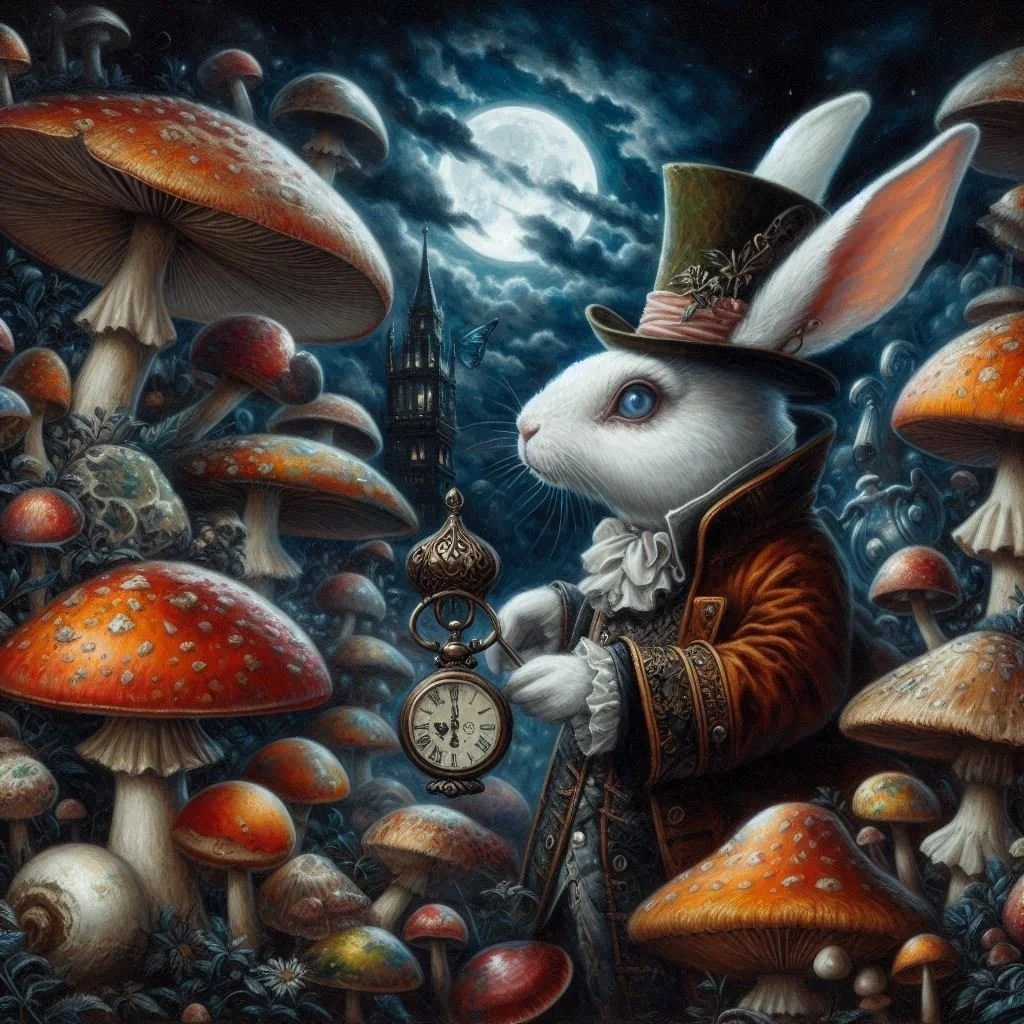
Fungi and altered states have maintained a persistent presence in Western popular culture for over half a century. The imagery, symbolism, and conceptual frameworks associated with psychedelic experience have moved through film, music, visual art, and — in more recent decades — internet subcultures and digital aesthetics. Tracking this cultural presence reveals something about how societies process and contain ideas that occupy ambiguous moral and legal territory.
Cinema: Psychedelic Experience as Film Language
Cinema has engaged with altered states since at least the 1960s, when the psychedelic movement provided both subject matter and formal influence. The challenge of representing subjective perceptual distortion on screen generated a range of cinematic strategies that have become part of the vocabulary of experimental and mainstream filmmaking.
Easy Rider (1969) included a peyote and LSD sequence that represented, at the time, a relatively unmediated attempt to translate subjective altered-state experience to film. The sequence used rapid editing, superimposition, and unconventional framing in a way that was stylistically influential on subsequent representations of drug experience in mainstream cinema.
Ben Wheatley’s A Field in England (2013) is a more recent and formally rigorous engagement with psychedelic experience in film. Set during the English Civil War, the film depicts the consumption of foraged mushrooms and the psychological disintegration that follows, using black-and-white cinematography, long takes, and an unsettling sound design. Its approach is analytical rather than celebratory — it treats altered states as disturbing and disorienting rather than revelatory, which places it at some distance from the reverential tone of much psychedelic cinema.
Brazilian director Gaspar Noé’s work — including Enter the Void (2009) and Climax (2018) — uses psychedelic and drug-induced states as a basis for extended formal experimentation with camera movement, light, and duration. These films treat altered states as a condition for exploring consciousness and perception rather than as narrative events, reflecting a distinctly post-countercultural aesthetic orientation.
Music: From Psychedelic Rock to Electronic Culture
The relationship between psychedelic substances and popular music was institutionalised in the 1960s. Psychedelic rock emerged in the mid-1960s as a genre explicitly associated with — and in many cases directly influenced by — LSD and other substances. Artists including The Beatles, Jefferson Airplane, The Doors, and Pink Floyd developed sonic vocabularies (extended improvisation, studio experimentation, dissonance, tape manipulation) that were framed as correlates or products of altered-state experience.
The cultural legacy of this period structured subsequent engagements between music and altered states across several decades. Electronic dance music culture — particularly techno, rave, and their derivatives from the late 1980s onward — maintained a functional relationship between substance use and musical experience that was less explicitly symbolised but structurally central to the social context in which the music was consumed.
Contemporary music genres including ambient, drone, and certain strains of experimental electronic music maintain aesthetic connections to altered-state experience without the explicit cultural framing of 1960s psychedelia. Artists such as Brian Eno, Boards of Canada, and Jon Hopkins have produced bodies of work that audiences and critics routinely describe in terms derived from altered-state phenomenology — expansiveness, timelessness, dissolution of boundaries — though the music itself is genre-agnostic with respect to substance use.
Internet Culture: Fungi as Visual and Memetic Subject
The internet has generated a distinctive relationship with fungal imagery and psychedelic aesthetics that differs in important respects from the countercultural contexts of the 1960s and 1970s. Online communities centred on cultivation, mycology, harm reduction, and psychedelic culture have developed largely in parallel with — and often at some critical distance from — the mainstream cultural and commercial framings of psychedelic substances.
Reddit communities including r/unclebens, r/mushroomgrowers, r/microdosing, and r/RationalPsychonaut have developed norms of technical precision and harm-reduction orientation that represent a significant departure from the guru-inflected, transformation-focused discourse characteristic of 1960s psychedelic culture. These communities prioritise information quality, source citation, and nuanced discussion of adverse effects alongside positive experiences.
Mycology as an aesthetic and intellectual interest has experienced substantial growth online, partly through the influence of Paul Stamets — whose work on fungal ecology, medicinal mushrooms, and mycoremediation has reached very large popular audiences through podcasts, documentary appearances, and social media. This mainstreaming of mycology as a subject of general interest has occurred partly independently of the psychedelic context, though the two domains overlap significantly in online discourse.
Biohacker Culture and Psychedelic Aesthetics
The integration of psychedelic substances — particularly psilocybin microdosing — into biohacker culture has generated a distinct aesthetic and discursive register. Biohacker communities tend to frame psychedelic substances in quantitative, performance-oriented terms: mood scores, productivity metrics, HRV data. The visual culture associated with this framing is deliberately non-countercultural: clinical, data-driven, oriented toward self-optimisation rather than liberation or transcendence.
This represents a significant cultural recontextualisation. The same substances that were framed as tools for political and spiritual liberation in the 1960s are now discussed in contexts of executive performance, workplace cognition, and personal productivity. Whether this represents cultural normalisation, co-optation, or simply a different set of user populations with different orientations is a matter of ongoing cultural analysis.
Underground Media and Harm Reduction Aesthetics
Outside mainstream cultural channels, a substantial ecosystem of podcasts, YouTube channels, newsletters, and online communities produces content oriented toward harm reduction, cultivation education, and critical engagement with psychedelic culture. The aesthetic of this media tends toward the understated and informational: avoiding the mystical imagery and transformation narratives that characterise commercial wellness framing, and instead prioritising technical accuracy and epistemic humility.
Platforms including Psymposia, Third Wave, and Chacruna Institute produce content that blends advocacy with research literacy, drawing on both academic sources and practitioner knowledge. This media occupies a different cultural niche than both the countercultural legacy press and the mainstream wellness media that has adopted microdosing as a product category.
Fungal Ecology as Cultural Subject
Merlin Sheldrake’s Entangled Life (2020) represented a significant moment in the cultural mainstreaming of fungal ecology. The book brought detailed scientific discussion of fungal biology, mycorrhizal networks, and interspecies communication to a very large popular audience, generating substantial media coverage and public interest in mycology that extended well beyond the psychedelic context.
This fungal ecology framing — which emphasises interconnection, distributed intelligence, and the ecological importance of decomposer organisms — has influenced how fungi are represented in design, visual art, and popular media. Documentary productions including Fantastic Fungi (2019) combined Sheldrake’s ecological perspective with psychedelic research context, reaching audiences who may not have engaged with either subject through traditional channels.
The resulting cultural moment — in which fungal biology, psychedelic research, and broader ecological consciousness have converged in public discourse — represents a distinctive feature of the early 2020s that is still developing. How durable this convergence proves, and whether it develops into lasting changes in how fungi are understood and represented in mainstream culture, remains to be seen.
Continue Reading
- The Cultural and Scientific History of Psilocybin Research
- Why Microdosing Became Popular in European Wellness and Biohacker Culture
- How Psilocybin Species Adapt to Different Natural Environments
Weekly Fungal Systems Briefing
Join the weekly fungal systems briefing for research summaries, cultivation systems analysis, and European mushroom industry updates.

