




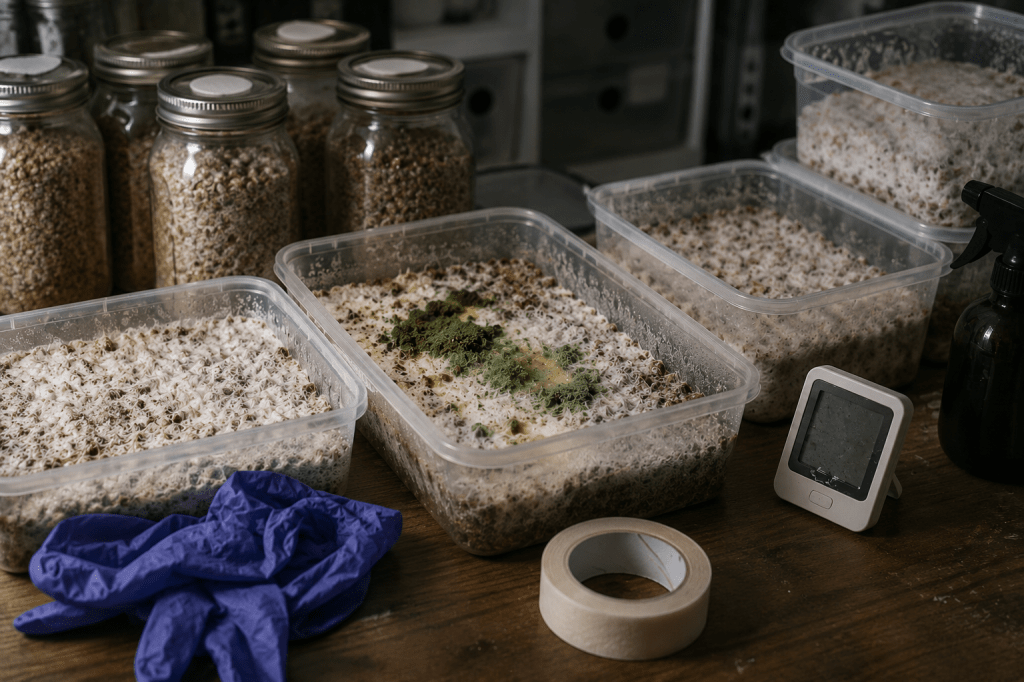
Contamination that happens once is a loss. Contamination that happens repeatedly across multiple batches is a process problem — and process problems have identifiable causes.
The mistake most growers make with recurring contamination is treating each batch as an isolated event. They adjust one variable, run another batch, and if it contaminates again, assume they have bad luck or a contaminated environment. The actual cause is usually still there, unchanged, because it was never correctly identified.
Stage 1: Sterilisation failures (contamination days 0–7, widespread)
The most common cause of early, widespread contamination is incomplete sterilisation or pasteurisation. The substrate still contained viable contaminant spores when inoculation occurred.
The most frequent sterilisation failure is insufficient time at pressure. 15 PSI for 2.5 hours is the standard minimum for grain substrates. Most contamination attributed to “bad luck” in the first week traces back to shorter times, insufficient pressure due to a faulty gauge, or overloading the pressure cooker so heat distribution was uneven.
Large grain jars (quart-size and above) require longer sterilisation times than smaller containers. The centre of the jar is the last point to reach sterilisation temperature. Substrate that is too dry does not conduct heat evenly — field capacity moisture, where a handful squeezed firmly releases only a few drops, is the target.
Stage 2: Inoculation failures (contamination days 0–14, localised)
Contamination that appears in the first two weeks near inoculation points indicates the contamination source was the inoculation process itself.
A contaminated syringe or liquid culture introduces contaminants directly into the substrate. Signs: contamination appears specifically at or near inoculation points, not distributed across the substrate. Testing liquid culture on agar plates before using it on grain is the standard verification step.
Inoculation performed in open air exposes the substrate to ambient contaminants. A still air box significantly reduces contamination rates for growers without laminar flow hoods. Contamination rates that are inconsistent — some jars contaminate, others from the same batch do not — typically indicate inoculation environment is the variable.
A needle that contacts non-sterile surfaces between inoculations transfers contamination. Flame-sterilising the needle between inoculations is standard practice.
Stage 3: Physical breach (contamination days 7–21, localised surface)
Contamination appearing during active colonisation — after the first week but before fruiting — usually indicates something entered from outside the container.
Grain bags develop micro-tears that are not visible to the naked eye, particularly at fold points and along the base where substrate weight creates stress. A bag that contaminated at the same point on consecutive batches has a structural weak point.
Filter patch bags are a common point of entry if the filter becomes wet or if the substrate creates a moisture pathway to the filter. Jar lids that are not fully tightened or polyfill ports that are inadequately packed allow air exchange that bypasses filtration.
Stage 4: Fruiting environment (contamination at or after pinset)
Contamination appearing after pins form involves a different set of variables. The substrate is open to the environment, physical contact occurs, and moisture management shifts.
Insufficient FAE is the primary driver of late-stage contamination. High CO₂ levels combined with high humidity create conditions that favour Trichoderma and cobweb mould over mushroom development. [See: Trichoderma vs Cobweb Mold — identification and response.]
Water pooling on the substrate surface or on developing pins is a contamination pathway. Harvesting without gloves, using unwashed tools, or leaving spent substrate on the surface between flushes are consistent sources of fruiting-stage contamination. [See: Common Monotub Contamination Mistakes — fruiting stage variables.]
Diagnosing recurring contamination systematically
If contamination is recurring, work through these questions in order:
1. When does it appear? Days 0–7 → sterilisation. Days 0–14 at inoculation points → inoculation. Days 7–21 → physical breach. Fruiting stage → environment and hygiene.
2. Where does it appear? Widespread → sterilisation failure. Localised surface → breach or inoculation. At pins or fruit → FAE, moisture, hygiene.
3. Is the pattern consistent? Same timing, same location across multiple batches points to the same cause. Inconsistent patterns suggest multiple variables or an environmental source.
4. What changed between a clean run and a contaminated run? Any change in substrate source, sterilisation time, inoculation environment, or container type is a candidate cause.
The contamination matrix in the Environmental Calibration Sheet provides a printable reference for this diagnostic process — timing and location mapped to entry points and corrective actions. Get the sheet →
The most common recurring contamination scenario
The most common pattern: contamination appears in the first week, widespread across the substrate, consistently across batches. The grower has adjusted inoculation technique, changed syringes, and cleaned the growing environment. The contamination continues.
The cause is almost always sterilisation. The adjustment that resolves it is extending pressure cooking time, verifying pressure gauge accuracy, or reducing load size per run.
Sterilisation is the step most growers assume is sufficient and the step most frequently responsible for persistent contamination.
The Environmental Calibration Sheet maps contamination patterns to their entry points across all cultivation phases. Free with newsletter subscription. Get the sheet →


Leave a comment