


The monotub is one of the most forgiving cultivation formats for environmental management — large substrate mass buffers temperature and humidity, and the design allows for relatively passive gas exchange. But it is also a format where small setup mistakes compound across a longer colonisation period and produce contamination that is harder to attribute to a single cause.
Most monotub contamination traces back to one of a small set of repeatable mistakes. This covers the most common ones by phase.
Setup mistakes
Substrate too wet. Excess moisture in bulk substrate is the single most common source of monotub contamination. A substrate packed at the wrong moisture level creates anaerobic pockets and supports bacterial growth. The field capacity test: a firmly squeezed handful should release only a few drops. If water streams freely, the substrate is too wet.
Grain spawn ratio. Standard guidance is 20–30% grain spawn by volume of bulk substrate. Dropping below this ratio extends colonisation time and increases contamination risk proportionally. A higher ratio — towards 30% — is particularly useful in environments with ambient contamination pressure.
Mixing technique. Not mixing spawn evenly through the substrate means colonisation proceeds unevenly. Pockets of substrate that are colonised later remain vulnerable for longer. Thorough mixing shortens overall colonisation time.
Hole placement and polyfill
The holes in a monotub serve two functions: fresh air exchange and humidity buffering. Their placement and fill material affect both contamination risk and fruiting conditions.
Hole position. Holes positioned too low in the tub allow direct contact between substrate and the outside environment during colonisation. Standard positioning is in the upper third of the tub sides, above the substrate level.
Polyfill function. Polyfill provides filtration for air entering through the holes. It must be packed firmly enough to function — loose polyfill allows unfiltered air through. Polyfill that becomes wet loses filtration properties.
Lid management during colonisation. During colonisation, the lid should remain closed or nearly closed to maintain humidity. Excessive FAE during colonisation dries out the surface and can crack the substrate, creating contamination pathways. The lid-crack FAE approach is a fruiting-stage variable, not a colonisation variable.
Contamination during colonisation
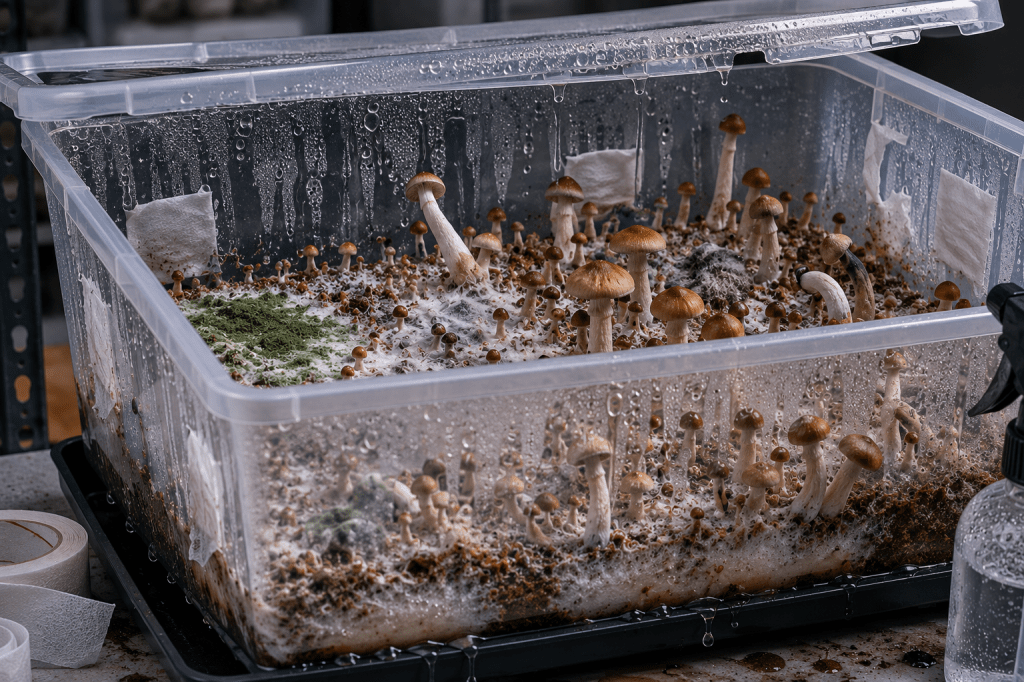
Healthy colonisation: white, dry mycelium spreading evenly through the substrate, with a clean, slightly earthy smell.
Green patches indicate Trichoderma. Isolate and discard immediately — do not wait to monitor. [See: Trichoderma vs Cobweb Mold — identification and response.]
Wet, discoloured patches with a sour smell indicate bacterial contamination, typically tracing to substrate moisture level or sterilisation. [See: Why Your Substrate Keeps Contaminating — sterilisation failure variables.]
Uneven colonisation with a dry, cracked surface indicates FAE too high during colonisation, or substrate moisture too low. Not contamination itself, but creates entry points.
Fruiting stage mistakes
Premature fruiting conditions. Introducing light and increased FAE before the substrate is fully colonised can trigger premature pinning in uncolonised zones. These premature pins typically abort and leave necrotic organic matter on the surface — a contamination substrate.
Surface moisture management. Monotubs produce significant condensation on the tub walls and lid. When condensation from the lid drips back onto the substrate surface, it creates moisture accumulation that supports contamination. Tilting the lid slightly to direct condensation to the tub sides reduces this pathway.
Spent pin removal. Aborted pins and spent substrate left on the surface between flushes are the primary vector for fruiting-stage contamination. Remove spent pins and abort sites between flushes, and clean the surface layer with gloved hands or a sanitised tool.
Misting frequency. Monotubs rarely need direct misting — the large substrate mass retains humidity well. Over-misting pools water on the surface. If the internal walls are visibly wet and the substrate surface looks moist, additional misting is adding moisture, not maintaining it.
Pattern: contamination appears only in certain areas
If contamination appears consistently in the same location across runs — the same corner, near a specific hole — that location is the entry point: physical breach, condensation pathway, or insufficient polyfill coverage.
If contamination appears across the full substrate early in colonisation, the substrate itself or the spawn is the source. [See: How to Identify Mushroom Contamination — timing and location as diagnostic variables.]
Summary
Most monotub contamination comes from a short list of causes: substrate moisture too high, insufficient spawn ratio, polyfill failure, lid condensation drip, or spent material not cleared between flushes.
Identifying which is responsible requires two variables: when the contamination appeared and where it is located. Those two data points, mapped against your process, identify the cause more reliably than any single corrective action applied without diagnosis.
The Monotub Quick Reference section of the Environmental Calibration Sheet covers hole placement, polyfill function, lid crack as FAE variable, humidity buffering, substrate depth, and contamination isolation. Get the sheet →


Leave a comment