
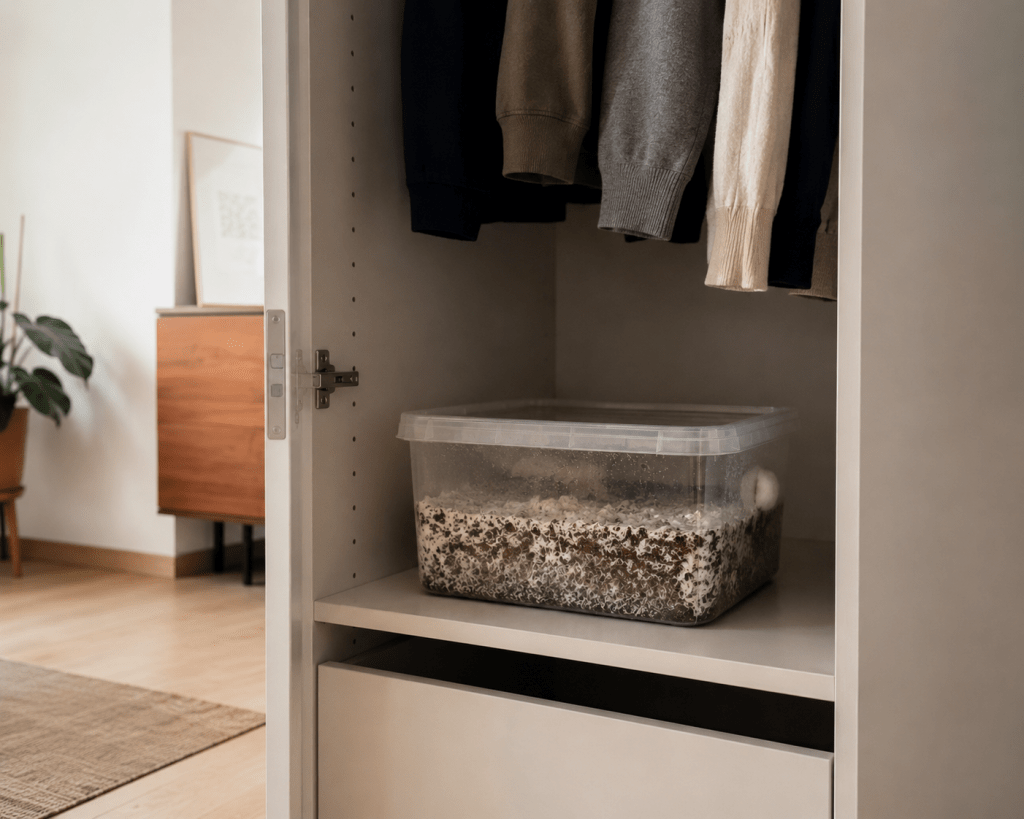
Most mushroom cultivation guides assume you have a spare room, a closet you can dedicate to growing, or at minimum some tolerance for a visible setup. If you’re in a small apartment — renting, short on space, or sharing with others who don’t want mushrooms colonizing the living room — the calculus is different. This guide covers how to run a functional, compact, low-footprint grow in an apartment context without compromising results.
The Core Constraint: Space vs. Environment
Small apartment grows are fundamentally an optimization problem. You’re trading some yield potential and batch size for discretion and space efficiency. The good news: the biology doesn’t care about your floor plan. A well-managed small tub in a wardrobe corner will outperform a neglected large setup every time.
The two variables that apartment constraints affect most are fresh air exchange (FAE) and humidity management. In a dedicated grow room you can dial in ambient conditions with equipment. In an apartment, you’re working with ambient room conditions and compensating with your container design. Understanding this difference is what makes small setups succeed or fail.
Choosing the Right Setup Size
For apartment grows, the realistic options by footprint are:
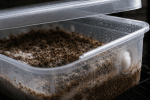
- Mini monotub (6–15L): A small clear storage box with polyfill holes. Fits on a shelf, inside a wardrobe, or under a desk. Produces modest yields but requires minimal space and is easily hidden. Best for growers who want a low-commitment first grow.
- Standard monotub (50–66L): The most common apartment setup. Fits inside a wardrobe or on a large shelf. Requires about 40–50 cm of depth and 60–70 cm of width. Produces enough for personal use from 2–3 flushes.
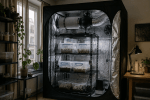
- Martha tent (small): A compact greenhouse tent (60×60×140 cm) with an ultrasonic humidifier and small fan. Produces more than a monotub but requires a corner of a room and visible equipment. Less discreet, more controllable.
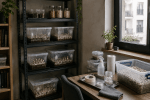
For most apartment growers, a standard monotub inside a wardrobe is the best balance of yield, discretion, and simplicity. The wardrobe provides darkness during colonization, some thermal buffering, and keeps the setup out of sight.
Temperature Management Without a Dedicated Space
Apartments in Europe tend to run 18–23°C during the winter heating season and fluctuate more during summer. This range works reasonably well for cultivation, but the challenge is consistency. Mycelium is tolerant of temperature variation in short windows but stalls or stresses if temperature swings beyond 5°C within a single day.
Practical strategies for apartment temperature management:
- Inside a wardrobe or cabinet: The enclosed space buffers against rapid ambient temperature changes. Even a thin wardrobe with a closed door maintains a more stable microclimate than open shelving.
- Near an interior wall: Interior walls in apartments hold heat more evenly than exterior walls, which can cool rapidly overnight. Placing your tub against an interior wall reduces temperature variation.
- Small seedling heat mat (under the tub, off during fruiting): A low-wattage heat mat can raise colonization temperatures 2–5°C above ambient. This is especially useful in cooler months. Remove or turn off during the fruiting phase — you want a slight temperature drop to trigger pins.
Avoid placing the tub near windows in summer or near cold exterior walls in winter. Both create the kind of temperature extremes that stress mycelium and open windows for contamination.
Humidity in an Apartment Context
Apartments in Northern and Central Europe often run 35–55% ambient relative humidity, which is lower than what fruiting mushrooms prefer (80–95%). This doesn’t mean you need a humidifier — it means your fruiting chamber design needs to compensate.
For a monotub: the bulk substrate itself is a massive humidity reservoir. A properly hydrated 10-liter substrate block releases moisture slowly throughout colonization. The tub design (lid on, polyfill holes) maintains high internal humidity without any active humidification during colonization. During fruiting, misting the walls of the tub 1–2 times daily — not directly onto the mycelium surface — maintains the surface moisture pins require.
If your apartment is particularly dry (below 35% RH, common in winter with central heating), consider placing a small open container of water near the tub — not inside it — to raise ambient humidity in the surrounding microclimate. A wardrobe with a glass of water inside runs noticeably higher ambient humidity than an open room.
Tracking ambient humidity helps you understand when to mist more or less. A basic digital hygrometer placed near (not inside) the tub gives you actionable data. For model comparisons and placement strategy, see our guide to mushroom hygrometers.
Fresh Air Exchange Without a Ventilation System
FAE is the variable apartment growers most frequently underestimate. In a dedicated grow room, a small inline fan and carbon filter handle CO₂ continuously. In an apartment, you’re doing this manually — and that’s fine, as long as you do it consistently.
For a monotub, passive FAE through polyfill holes handles CO₂ during colonization. During fruiting, fanning the open tub for 30–60 seconds, once or twice a day, drops CO₂ sufficiently to maintain pinning. Use a clean hand or a small battery-powered fan held at tub distance — not a full-size room fan pointed directly into the tub, which desiccates the surface.
If you’re in a small apartment with low ceiling height or limited ventilation, open a window briefly while fanning to refresh room air before introducing it to the tub. This helps ensure you’re not recirculating stale air with elevated CO₂ from your own respiration. In a bedroom, fanning after you’ve been out for a few hours gives the room air a chance to equilibrate.
Contamination Risk in Shared Living
Apartments, especially shared ones, have higher baseline contamination pressure than dedicated grow spaces. Kitchen activity, cooking steam, and general foot traffic all introduce airborne spores and mold pressure into the environment. This doesn’t make growing impossible, but it does mean certain practices matter more.
- Don’t open the tub in the kitchen. Kitchens have the highest airborne contamination load in most homes. Do any tub inspection or fanning away from cooking areas.
- Time your inoculations for when the apartment is calm. Less foot traffic, less ambient contamination. Early mornings before cooking or late evenings work well.
- Wipe down the wardrobe interior with isopropyl before starting a grow. Dust and organic material that accumulates in enclosed spaces can harbor competitor molds. A quick wipedown before introducing your tub reduces baseline contamination pressure.
- Keep colonization sealed. The single most important contamination prevention step is simply not opening the tub during colonization. The polyfill holes handle FAE; you don’t need to open the lid to check on it.
For a full breakdown of the environmental mistakes that lead to contamination, see Why Most Beginner Mushroom Grows Fail.
Realistic Yield Expectations
A well-run standard monotub (66L) in an apartment produces 20–60g dry per flush, with 2–3 viable flushes. That’s 40–180g dry per complete grow cycle, which for most personal-use growers is more than adequate. A mini monotub (10–15L) produces roughly a quarter of that.
These numbers assume optimal substrate hydration, healthy grain spawn, and consistent environmental management. Beginners often see lower yields on their first grow — less from the equipment and more from learning the FAE and misting rhythm. The second grow consistently outperforms the first once those rhythms are established.
For a complete walkthrough of environment setup and equipment selection that applies directly to apartment grows, see Beginner Indoor Mushroom Cultivation. For monotub-specific setup instructions, Monotub Setup Explained covers every step.


Leave a comment